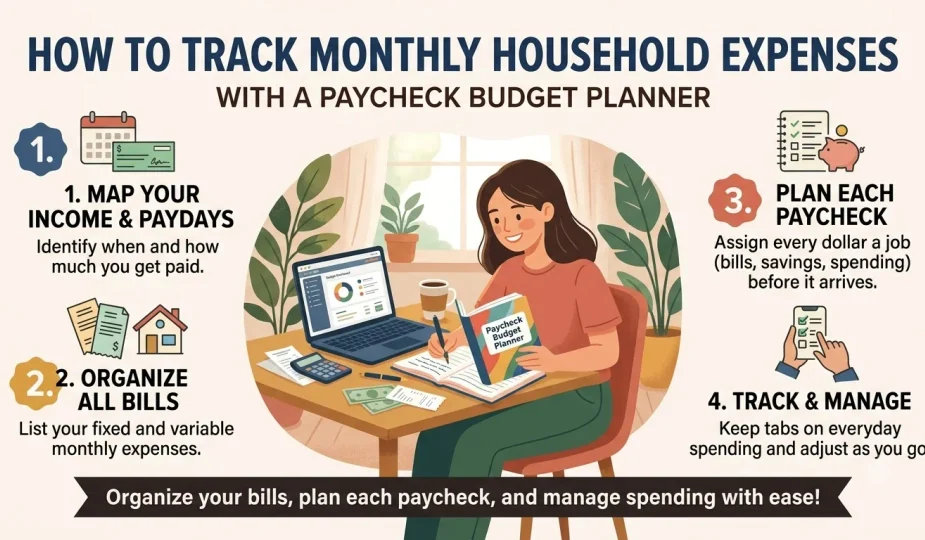
Managing household expenses can feel confusing even when you have a steady paycheck. Rent or mortgage payments, groceries, utilities, gas, insurance, subscriptions, and unexpected purchases all compete for the same money. You might pay the important bills on time and still wonder where the rest of your paycheck went.
The problem often isn’t that you’re bad with money. It’s that household expenses arrive on different dates, some costs change every month, and small purchases are easy to forget. Without a simple way to track everything, it’s difficult to know how much money is available until your next payday.
A Paycheck Budget Planner can help you organize your income, assign money to upcoming expenses, and keep track of what you’ve already spent. Instead of trying to remember every bill and purchase, you can create a clear plan for each paycheck.
I’m Prince Mali, the blogger behind Organised My Home, where I share practical ideas and simple planning tools to make everyday household management easier. In this guide, you’ll learn how to track monthly household expenses, organize bills around your paydays, and use a paycheck budget planner to build a routine that works for your household.
Why Is It So Hard to Keep Track of Monthly Household Expenses?
Household budgeting sounds straightforward: add up your income, subtract your expenses, and see what’s left. But real life isn’t always that simple.
Your electricity bill might be higher this month. Your grocery spending might increase when family visits. An annual insurance payment may be due just when you need to buy school supplies or replace something at home.
According to Consumer.gov’s guide to making a budget, a practical budget starts with recording income and expenses, comparing the two, and reviewing your spending regularly. The guide also recommends using your budget throughout the month rather than creating it once and forgetting about it.
Here are some common reasons household expenses become difficult to manage.
1. Bills Have Different Due Dates
Rent may be due at the beginning of the month, your phone bill in the middle, and your car payment later. If you’re paid every two weeks, your payday schedule may not line up neatly with those due dates.
You can have enough income for the month overall but still feel short on cash during a particular week.
2. Small Purchases Are Easy to Overlook
A coffee on the way to work, a quick grocery trip, a streaming subscription, or an online purchase might not seem significant on its own. However, when you don’t record these expenses, it’s easy to underestimate how much you’ve spent.
3. Monthly Expenses Aren’t Always the Same
Groceries, electricity, gas, transportation, and household supplies can vary. You may also have less frequent expenses, such as car repairs, medical costs, gifts, or annual renewals.
Ignoring these costs can make an otherwise reasonable budget difficult to follow.
4. You Don’t Have One Central Place to Track Everything
Your bills may be in email, receipts in a drawer, subscriptions on your phone, and spending details in your banking app. Each source holds part of the picture, but bringing everything together takes effort.
The solution isn’t necessarily a more complicated budget. Often, you need a simpler system that makes your income, expenses, and next payday easy to see.
What Is a Paycheck Budget Planner?
A Paycheck Budget Planner is a budgeting worksheet or printable that helps you organize your money around the paychecks you receive.
Instead of looking only at your total monthly income, you plan how each paycheck will cover bills, household needs, savings goals, and everyday spending until the next payday.
For example, if you receive a paycheck every other Friday, you can list the bills due before your next paycheck and decide how much of that check needs to be reserved for them.
A paycheck budget planner can help you track:
- Paycheck dates and take-home income.
- Rent or mortgage payments.
- Utilities, internet, phone, and insurance.
- Groceries, transportation, and household supplies.
- Debt payments and other financial obligations.
- Savings contributions and upcoming expenses.
- Actual spending and remaining money.
The goal isn’t to restrict every purchase or make your budget perfect. It’s to understand where your money needs to go before you spend it.
How to Keep Track of Monthly Household Expenses Step by Step
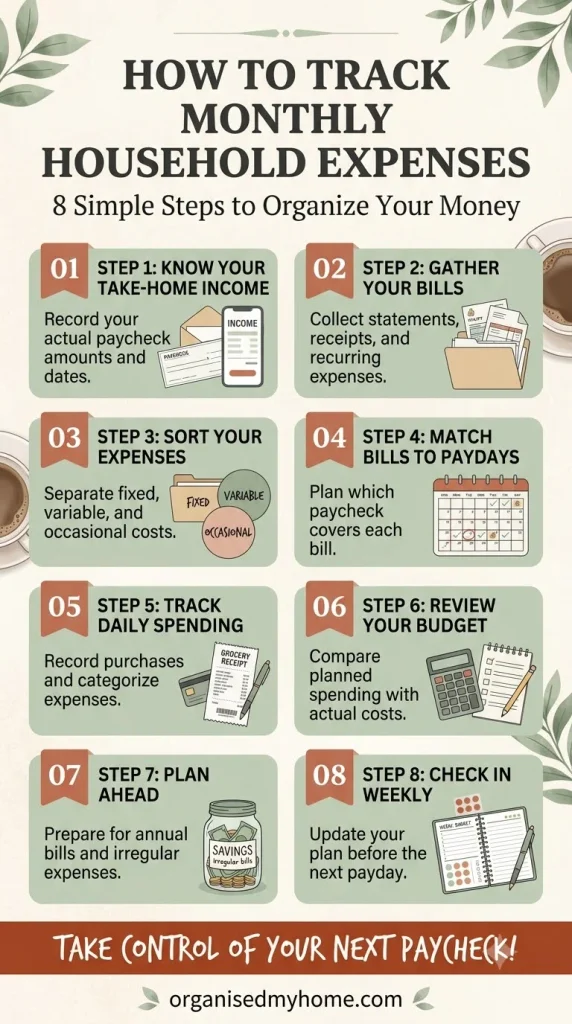
You don’t need to redesign your entire financial life to get started. Follow these practical steps to build a household expense tracking system you can maintain.
Step 1: Calculate Your Actual Take-Home Income
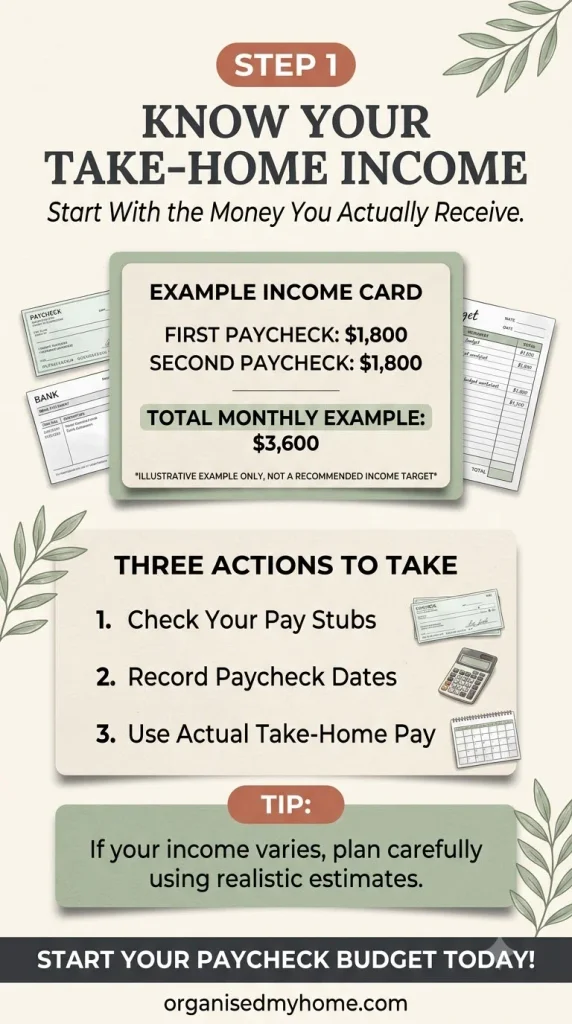
Start with the money that reaches your bank account, not your salary before taxes and deductions.
If you’re paid by an employer, check your pay stubs. If you have more than one income source, list each one separately. Include other income you can reasonably expect to receive during the budgeting period.
For example:
| Income source | Example amount |
|---|---|
| First paycheck | $1,800 |
| Second paycheck | $1,800 |
| Total take-home income | $3,600 |
These figures are illustrative, not a recommended income target.
If your income changes from month to month, use a conservative estimate based on your actual earnings and available records. Avoid assigning money you haven’t received yet to bills that must be paid now.
Your action: Write down each expected paycheck, its amount, and the date you expect to receive it.
Step 2: Gather Your Household Bills and Expenses
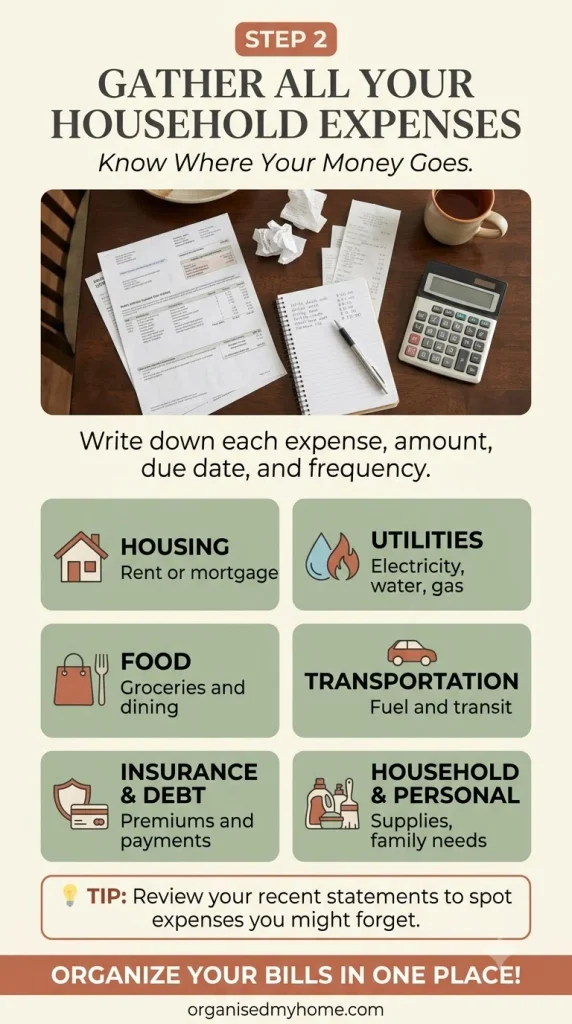
Before deciding where your money should go, find out where it currently goes.
Gather your recent bank and credit card statements, bills, receipts, pay stubs, and subscription details. Looking back over two or three months can help you identify expenses that don’t appear every month.
Divide your expenses into practical categories.
| Expense category | Examples |
|---|---|
| Housing | Rent, mortgage, property-related costs |
| Utilities | Electricity, water, gas |
| Communications | Internet, phone |
| Food | Groceries, takeout, dining out |
| Transportation | Fuel, public transit, car payments |
| Insurance and health | Premiums, prescriptions, medical costs |
| Household | Cleaning supplies, toiletries, basic repairs |
| Debt payments | Credit cards, personal loans |
| Personal and family | Clothing, school expenses, activities |
| Savings and irregular expenses | Emergency savings, annual renewals, gifts |
Don’t worry if your first list is messy. The purpose is to see the full picture, not to organize every detail perfectly on the first attempt.
Your action: Record the amount, due date, and frequency of each expense.
Step 3: Separate Fixed, Variable, and Occasional Expenses
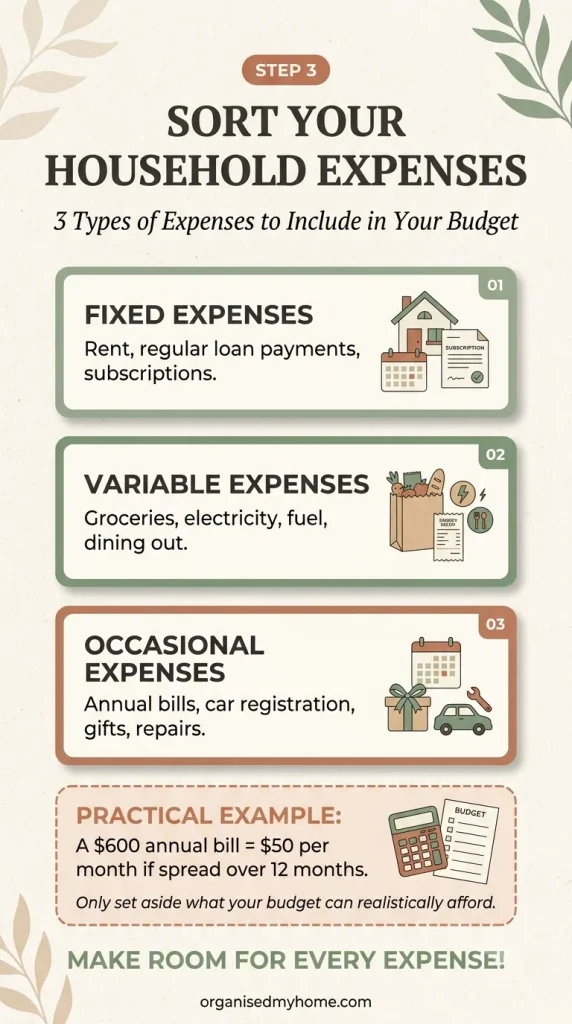
Once you’ve listed your expenses, sort them by how they behave.
Fixed expenses are relatively predictable, such as rent, a regular loan payment, or a subscription with a set fee.
Variable expenses change depending on usage or household needs. Groceries, electricity, fuel, and dining out are common examples.
Occasional expenses occur less frequently, such as annual insurance premiums, car registration, holiday gifts, or certain home repairs.
This third group is easy to overlook because it may not appear on a typical monthly bill list.
If you know an annual expense is coming, estimate its cost and decide how much you can set aside each month. For example, a $600 annual bill would require $50 per month if you wanted to spread the cost evenly over 12 months and your budget allowed it.
That doesn’t mean you must fund every expense in advance. Start with the upcoming costs that matter most to your household.
Step 4: Match Your Bills to Your Paychecks
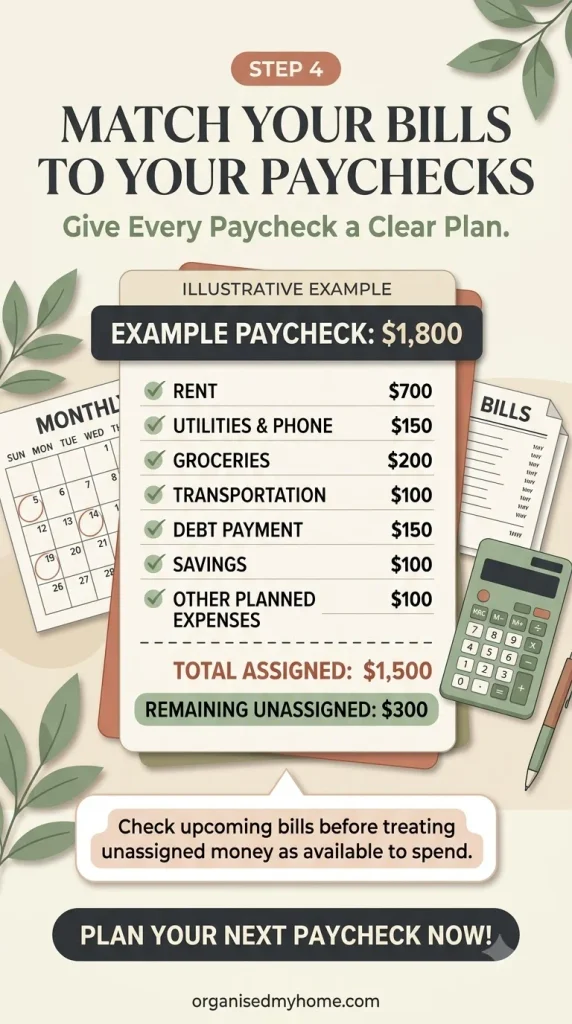
This is where a paycheck budget planner becomes particularly useful.
Write down your upcoming payday dates, then list the bills and essential expenses that need to be covered before the following paycheck.
For example, suppose your take-home paycheck is $1,800. You might plan it like this:
| Planned use | Example amount |
|---|---|
| Rent contribution | $700 |
| Utilities and phone | $150 |
| Groceries | $200 |
| Transportation | $100 |
| Debt payment | $150 |
| Savings contribution | $100 |
| Other planned expenses | $100 |
| Total assigned | $1,500 |
| Remaining unassigned | $300 |
This is only an illustration. Your own expenses, priorities, and due dates will be different.
Before deciding that the remaining $300 is available for spending, check whether other bills or essential costs are due before your next payday. Also account for any money already committed to expenses from previous pay periods.
Your action: Give every paycheck a job, starting with essential bills and near-term obligations. If the numbers don’t work, identify the shortfall early and consider what can realistically be adjusted.
Step 5: Record Everyday Spending
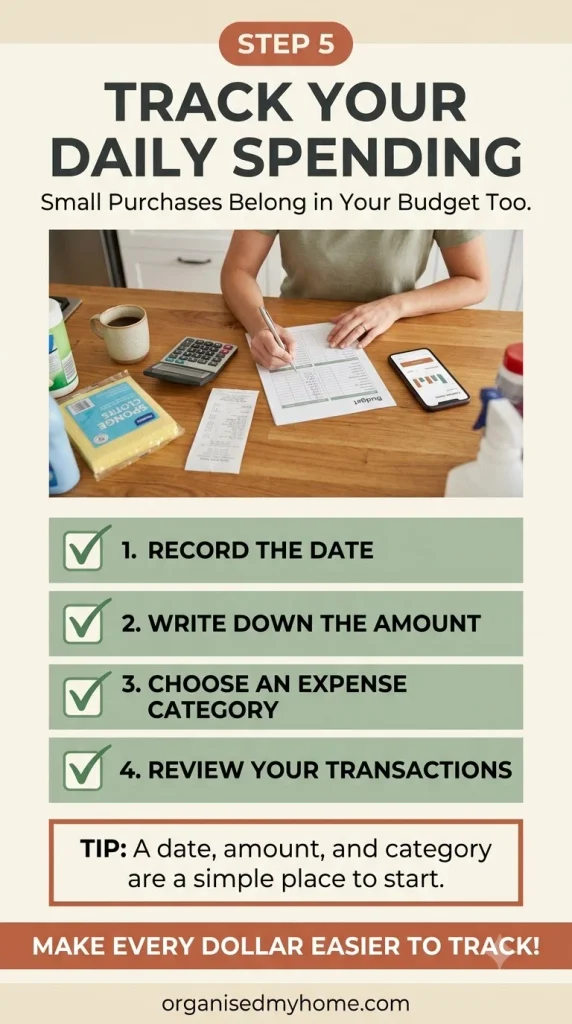
A budget is based on a plan, but your actual spending shows what happened.
Keep track of purchases throughout the week. You can use your bank’s transaction history, a notes app, receipts, or a printable spending tracker.
Record purchases in the appropriate category. For example, a trip to the grocery store belongs under food, while a bottle of laundry detergent belongs under household supplies if that is how you’ve organized your categories.
You don’t have to write a long explanation for every transaction. A date, amount, and category are often enough to start.
The Consumer Financial Protection Bureau’s spending guidance recommends reviewing actual expenses, including less frequent costs, rather than relying only on estimates.
Your action: Choose a consistent time to record your spending, such as after dinner or during a short weekly review.
Step 6: Compare Your Plan With What You Actually Spent
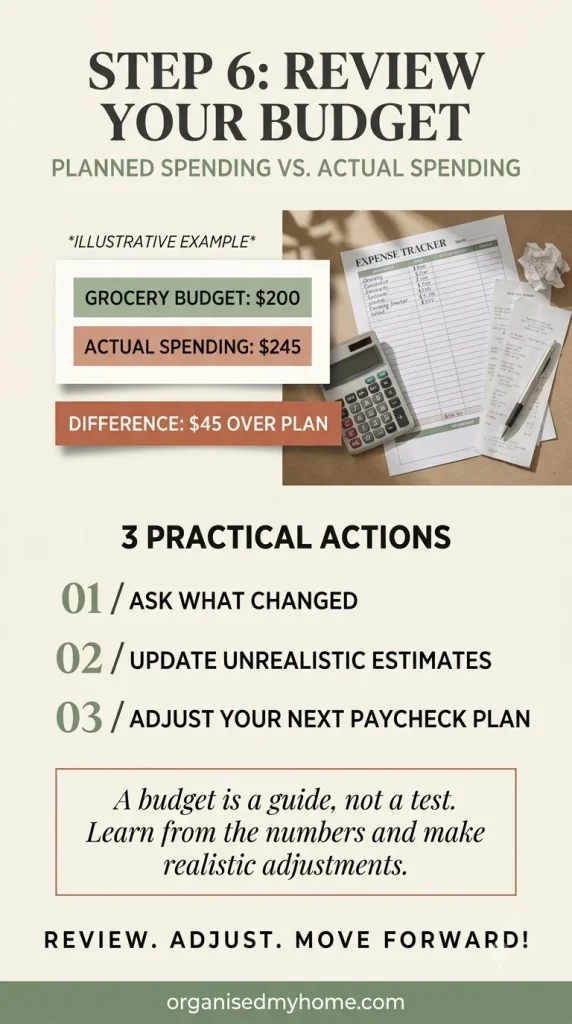
At the end of each week or paycheck period, compare your planned amounts with your actual spending.
Imagine you planned $200 for groceries but spent $245. Instead of treating this as a failure, ask a few useful questions:
- Did grocery prices or household needs increase?
- Did the category include something you normally track elsewhere?
- Was this an unusual week?
- Should next month’s grocery estimate be adjusted?
If your electricity bill regularly exceeds your estimate, update the budget to reflect reality. If a subscription is no longer useful, consider whether you want to keep paying for it.
A budget becomes more useful when it reflects your actual circumstances instead of forcing you to follow outdated numbers.
Your action: Record the difference between planned and actual spending, then make one or two realistic adjustments for the next pay period.
Step 7: Plan for Expenses That Don’t Arrive Every Month
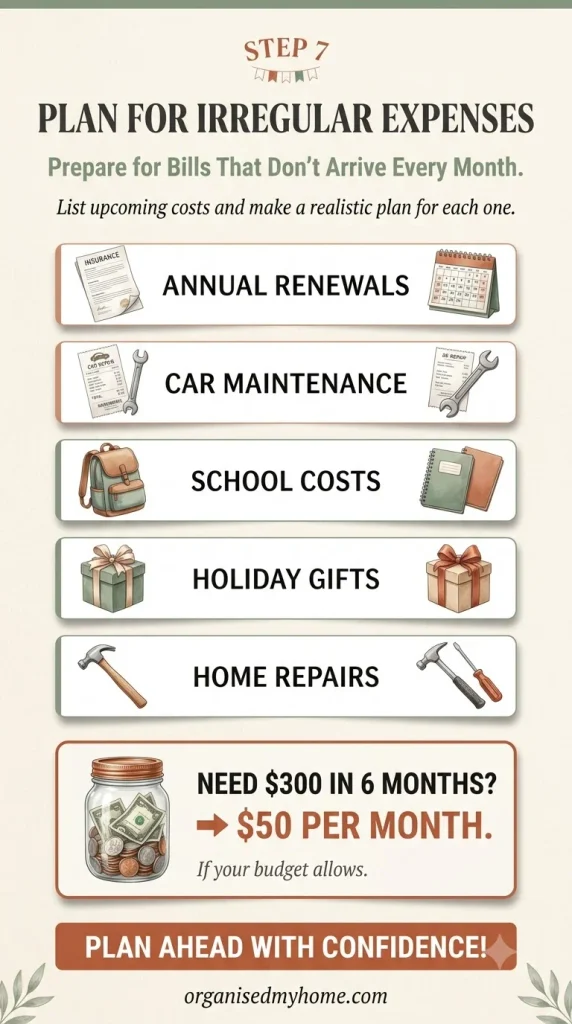
A monthly budget can look balanced until an irregular expense arrives.
Think about annual renewals, car maintenance, school costs, holiday spending, and household repairs. Review previous statements and receipts to identify expenses that might otherwise catch you off guard.
If a predictable expense is due in six months, divide the amount you need by the number of months remaining to see what monthly contribution would be required.
For example, if you need $300 for a planned expense in six months, setting aside $50 per month would cover it, provided you can afford that contribution.
If the expense is sooner, or your budget is already stretched, you may need a different plan. Don’t force a savings target that leaves essential bills unpaid.
Your action: Add known upcoming expenses to your planner and give them a realistic funding plan.
Step 8: Create a Simple Weekly Budget Review
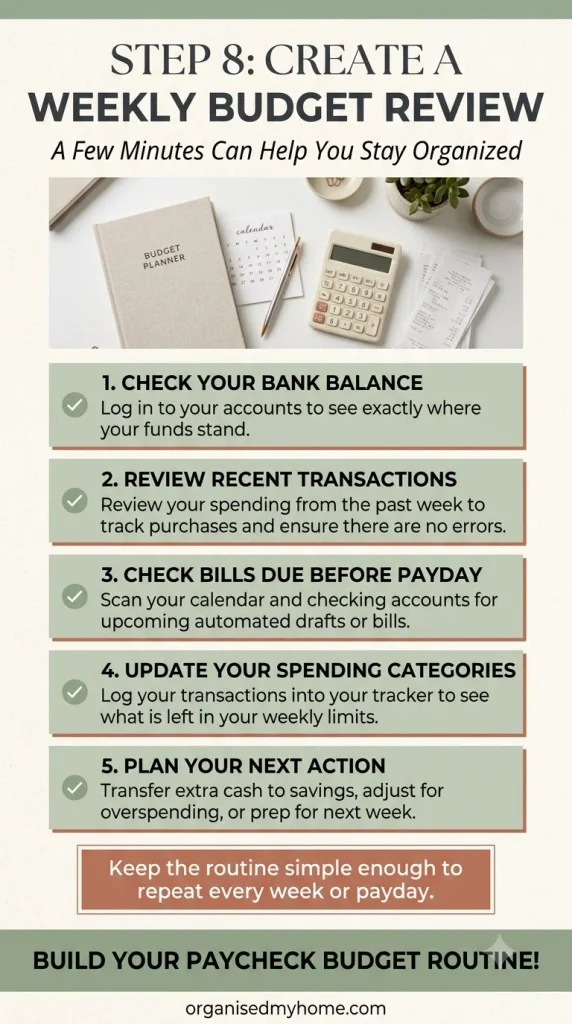
You don’t need to spend hours analyzing your finances every weekend. A short review can help you catch problems before the next payday.
During your review:
- Check your current bank balance and recent transactions.
- Review bills due before your next paycheck.
- Update your spending categories.
- Check how much you’ve allocated to essentials and other priorities.
- Note anything that needs attention before the next review.
Keep the process simple enough to repeat. If a weekly review feels like too much, start by checking your budget each payday and add a brief midweek check if useful.
Consistency matters more than creating a complicated system you won’t use.
What This Can Look Like in Real Life
Imagine a household where one person gets paid every other Friday and handles most of the monthly bills.
Before using a budget planner, they check their bank balance whenever they need to buy something. Rent is paid, groceries are purchased, and the phone bill is covered, but there’s no clear record of which upcoming expenses still need money.
A few days before payday, an automatic payment comes out. Suddenly, the balance is lower than expected. The problem isn’t necessarily overspending on one big purchase. Several small expenses and an upcoming bill simply weren’t included in the mental calculation.
Now imagine the same household using a Paycheck Budget Planner.
At the beginning of the pay period, they record the paycheck amount, list the bills due before the next payday, and assign money to groceries, transportation, and other essentials. As they spend, they update their records. During a short review, they notice that the next paycheck will need to cover an upcoming insurance payment.
They can plan for that bill instead of being surprised by it.
The planner hasn’t increased their income or eliminated every financial challenge. What it has done is make the next few decisions easier to understand.
That’s the practical value of a simple budgeting system: you can see what your money needs to cover before deciding what else you can afford.
Common Budgeting Mistakes That Make Expense Tracking Harder
Even a well-intentioned budget can become difficult to maintain if the system is too complicated or doesn’t reflect real life.
Trying to Track Too Many Categories
You don’t need a separate category for every item you purchase. Start with broad groups such as housing, food, transportation, utilities, and personal spending.
Add more detail only when it helps you understand a spending pattern or make a decision.
Forgetting Annual and Irregular Bills
A budget that includes only monthly payments may look more comfortable than your finances actually are.
Review previous statements and keep a list of upcoming expenses, even when they’re months away. This helps you account for costs that don’t arrive every month.
Treating Your Bank Balance as Your Available Spending Money
Your checking account may show $800, but some of that money could already be needed for rent, an upcoming automatic payment, or groceries before payday.
Your balance is important, but it doesn’t tell the whole story. Check what has already been committed before deciding how much is available.
Giving Up After One Difficult Month
Unexpected expenses, higher utility bills, or a change in income can disrupt your plan.
Instead of abandoning the budget, update it. A realistic budget should change when your circumstances change.
Making the System Too Complicated
If your budget requires too much writing, too many apps, or frequent calculations, you’re more likely to stop using it.
Start with the information you genuinely need: income, bills, due dates, planned spending, actual spending, and upcoming expenses. You can always add more detail later.
How a Paycheck Budget Planner Printable PDF Can Help
If you’re tired of keeping budget details in several places, the Paycheck Budget Planner Printable PDF from Organised My Home can be a practical starting point.
A printable gives you a dedicated place to record paycheck information, organize expenses, and review your plan. Rather than designing your own worksheets from scratch, you can begin with a ready-made planning format and adapt your routine to your household.
Depending on the pages included in your chosen planner, you can use it to organize information such as:
- Paycheck dates and take-home amounts.
- Bills that need to be paid during each pay period.
- Household spending categories.
- Planned and actual expenses.
- Upcoming costs and savings goals.
- Notes about adjustments for the next paycheck.
The key is to use the planner as part of a routine rather than treating it as a one-time worksheet.
Write down the information you need, keep it somewhere accessible, and update it when your income or expenses change. If you prefer digital banking for transactions, you can continue using it alongside your paper planner.
A printable doesn’t make financial decisions for you, but it can make the information behind those decisions easier to see.
Benefits of Using Printable Budget Planners
A printable PDF won’t suit every budgeting style, but it can be useful if you prefer a physical worksheet or want a clear overview without opening several apps.
1. Your Budget Information Is Easier to See
A paper planner can put your paychecks, upcoming bills, and spending categories on the same page. This makes it easier to review your plan without switching between multiple screens.
2. It Can Help You Build Consistency
Using the same worksheet each payday creates a repeatable process. You know where to record your income, where to list bills, and where to review your spending.
3. It May Save Time During Budget Planning
A ready-made format means you don’t have to design every heading and tracking section yourself. You can spend more time reviewing your actual expenses and less time creating the worksheet.
4. It Can Reduce Mental Clutter
When your budget lives only in your head, it’s easy to keep thinking about upcoming bills and whether you have enough money.
Writing down your plan gives you a reference point. You can check the information instead of repeatedly trying to remember it.
5. It’s Flexible
You can add notes, change categories, or print a fresh page when you need one. Your planner can evolve as your household expenses and income change.
6. You Can Combine Paper and Digital Tools
A printable doesn’t have to replace your banking app or calendar. You can use your bank to review transactions, a calendar for bill reminders, and a planner for your overall paycheck plan.
Choose the combination that feels easiest to maintain.
Why Choose an Organised My Home Paycheck Budget Planner?
Organised My Home creates practical printable resources designed to help people manage everyday household responsibilities with less confusion.
If you’re looking for a straightforward way to organize your paycheck budget, a ready-made printable can help you get started without building your own tracking pages.
Budget-Friendly and Practical
A printable PDF can be an accessible option for people who want a simple budgeting tool without purchasing an elaborate physical planning system.
The important thing is to choose a resource that suits your needs and use it consistently. A more expensive or complicated tool isn’t automatically a better fit.
An All-in-One, Ready-to-Use Starting Point
Starting with a blank sheet can be surprisingly difficult. You may wonder which categories to include, how to organize bills, or what information to record.
A ready-made planner provides a starting structure so you can focus on your own income, expenses, and upcoming financial responsibilities.
Use the sections that are relevant to your household, and avoid adding unnecessary complexity.
US Letter and A4 Paper Sizes
Organised My Home printables are available in both US Letter and A4 sizes, making them convenient for common printing needs in the United States and many other countries.
Choose the appropriate file for your paper, print at home or through a print service, and keep the pages in a binder or folder.
You can print the pages you need rather than maintaining a large physical planner if a smaller setup works better for you.
Free Printables From Organised My Home
You don’t have to purchase a printable to start organizing your household.
Organised My Home also offers selected free printables that let you try simple organization tools without making a purchase.
Browse the available free resources and choose something relevant to your current needs. You might begin by organizing one area of household management, then gradually build a broader routine.
If you’re working on more than your budget, you may also find it helpful to explore related Organised My Home topics:
- Weekly Home Cleaning: Create a manageable routine for everyday cleaning.
- Home Maintenance Checklist: Keep track of repairs, inspections, and recurring household tasks.
- Home Organization: Develop simple systems for keeping household responsibilities organized.
- Monthly Budget Planner: Review monthly income, expenses, and upcoming costs.
- Decluttering: Make it easier to manage household belongings and maintain organized spaces.
These are suggested topics to explore, not claims that a specific free worksheet is available for each one.
Ready to Organize Your Next Paycheck?
If you want a simple way to keep your household expenses in one place, explore the Paycheck Budget Planner Printable PDF at Organised My Home.
Use it to map out your next paycheck, record the bills due before payday, and review your spending as the week progresses. Start with the essentials, then gradually add savings goals and less frequent expenses as your system becomes more comfortable.
You don’t need to solve every budgeting challenge at once. A clear plan for the next paycheck is a useful place to begin.
Conclusion: Make Monthly Household Expenses Easier to Manage
Learning how to keep track of monthly household expenses starts with understanding your income, recording your bills, and planning around the dates your money arrives.
Gather your expense information, separate regular bills from variable and occasional costs, assign money to upcoming obligations, and review your actual spending. When something changes, adjust the plan instead of assuming you’ve failed.
A Paycheck Budget Planner can help you bring these details together in one visible system. It won’t eliminate unexpected expenses or make every month predictable, but it can help you approach your financial responsibilities with a clearer plan.
I’m Prince Mali, the blogger behind Organised My Home, where I share practical ideas and simple tools to make everyday home management easier.
If you’re ready to organize your next payday, explore the Paycheck Budget Planner Printable PDF or browse the available free printables to find a useful place to start.
You don’t need a perfect budget. You need a simple system you can return to, paycheck after paycheck.








[…] Explore More: How Do I Keep Track of Monthly Household Expenses? Paycheck Budget Planner […]