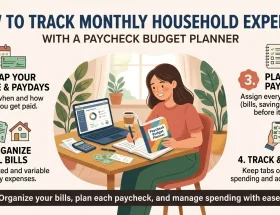
Have you ever paid the rent or mortgage, bought groceries, covered a few household bills, and then wondered where the rest of your paycheck went? You’re not alone in finding household expenses difficult to manage. Between electricity, internet, gas, groceries, insurance, subscriptions, and unexpected repairs, it can be hard to see the full picture of your family’s finances.
The problem isn’t always that you’re spending too much. Sometimes, expenses are scattered across bank statements, email receipts, automatic payments, and notes you meant to review later. Without a clear plan, even ordinary purchases can make the end of the month feel stressful.
A Home Budget Planner can help you bring those numbers together, understand where your money goes, and decide how to use your income more intentionally. The goal isn’t to stop enjoying life or make every purchase feel like a difficult decision. It’s to create a household budget that works with your actual income, responsibilities, and priorities.
At Organised My Home, blogger Prince Mali shares practical ideas and simple systems that help people manage everyday home responsibilities more easily. Just as a cleaning checklist can make household chores easier to organize, a budget planner can give your household expenses a clear, manageable structure.
You don’t need complicated spreadsheets or hours of calculations to begin. With a little preparation and a system you can review regularly, you can start making more informed decisions about your money.
Why Managing Household Expenses Can Feel So Difficult
Household spending rarely comes from one place. Your rent or mortgage might be predictable, but grocery prices change, utility bills fluctuate, and a car repair can appear without warning.
Several common problems can make budgeting harder than it needs to be.
- Forgetting small purchases: Coffee, takeout, convenience-store stops, and online orders can be easy to overlook when you review your spending.
- Ignoring irregular expenses: Annual insurance premiums, school supplies, holiday gifts, and home repairs may not appear in a typical monthly bill list.
- Relying on memory: Remembering every due date, payment, and spending limit creates unnecessary mental work.
- Setting unrealistic limits: A grocery budget that doesn’t reflect your household’s actual needs may be difficult to maintain.
- Making a budget once and forgetting it: A plan that never gets reviewed can quickly stop matching real life.
The Consumer Financial Protection Bureau recommends tracking spending to understand where money is going before building a workable budget. Its guidance also emphasizes reviewing bills, income, and spending habits as circumstances change. Read the CFPB’s budgeting guidance.
The important thing to remember is that struggling with a budget doesn’t mean you lack discipline. You may simply need a clearer way to see your financial responsibilities and make decisions one step at a time.
How a Home Budget Planner Can Help
A Home Budget Planner gives your household finances a dedicated place. Instead of searching through different records every time you need to check a bill or spending category, you can use one organized system to record your income, expenses, payment dates, and savings goals.
A printable budget worksheet can be particularly helpful if you prefer writing things down and keeping important information visible.
For example, you might use it to organize:
- Monthly take-home income
- Rent or mortgage payments
- Electricity, water, gas, internet, and phone bills
- Groceries and household supplies
- Transportation and childcare costs
- Insurance and debt payments
- Savings contributions and emergency expenses
- Flexible spending, such as dining out and entertainment
The Home Budget Planner Printable PDF from Organised My Home is one option for creating this kind of visual system. Rather than starting with a blank sheet and deciding how to arrange everything yourself, you can use a ready-made printable as a starting point.
A planner won’t change your spending automatically or solve every financial challenge. What it can do is make your numbers easier to review, help you identify the next step, and give you a consistent place to record progress.
How to Manage Household Expenses Step by Step
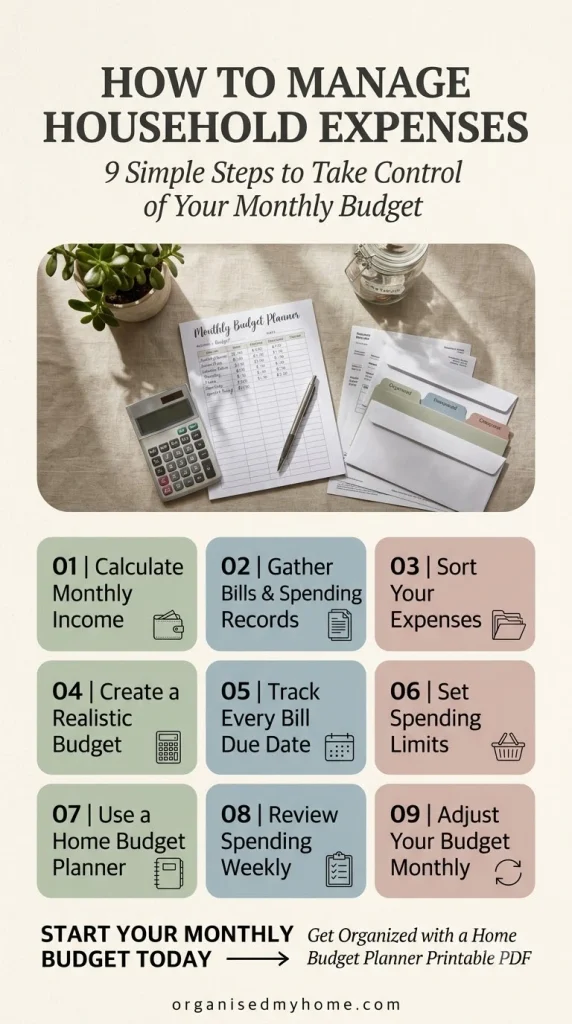
Step 1: Calculate Your Monthly Household Income
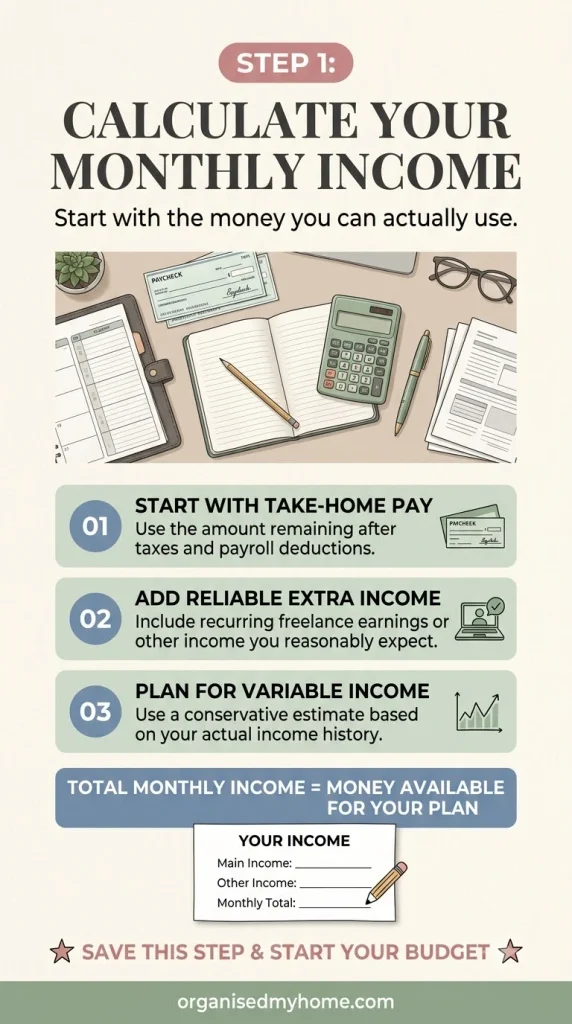
Start by figuring out how much money your household can realistically use each month.
For a straightforward budget, begin with take-home pay after taxes and payroll deductions. Include other reliable income that you expect to receive, such as regular freelance earnings or other recurring income.
If your income changes from month to month, avoid building your budget around your best month. Use a conservative estimate based on your actual income history, then adjust when you know what you’ll receive.
Write down the total at the top of your planner.
Your starting point: Monthly household income = the money available to cover your planned expenses and financial goals.
Step 2: Gather Your Bills and Spending Records
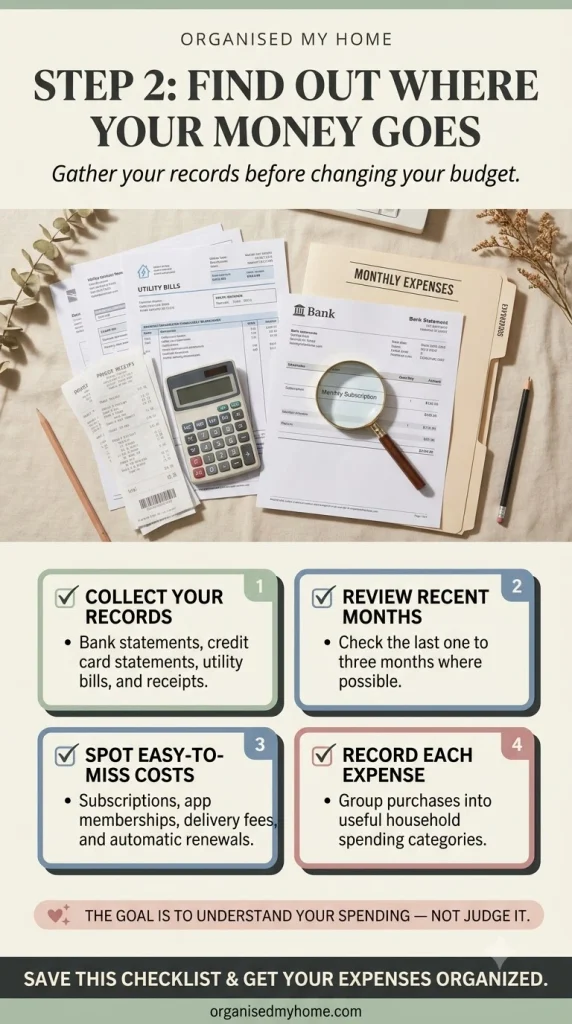
Before deciding where to cut back, find out what you’re currently paying.
Collect recent bank and credit card statements, utility bills, insurance notices, receipts, and payment records. Review the last one to three months if possible, particularly for expenses that change regularly.
Look for charges that are easy to miss, such as streaming subscriptions, app memberships, delivery fees, and automatic renewals.
Record each expense in the appropriate category. If you’re unsure how much you spend on groceries or fuel, use your recent records to estimate a realistic starting amount. You can refine it after tracking another month.
This step isn’t about judging past purchases. It’s about understanding your current situation before making a plan.
Step 3: Separate Fixed, Variable, and Occasional Expenses
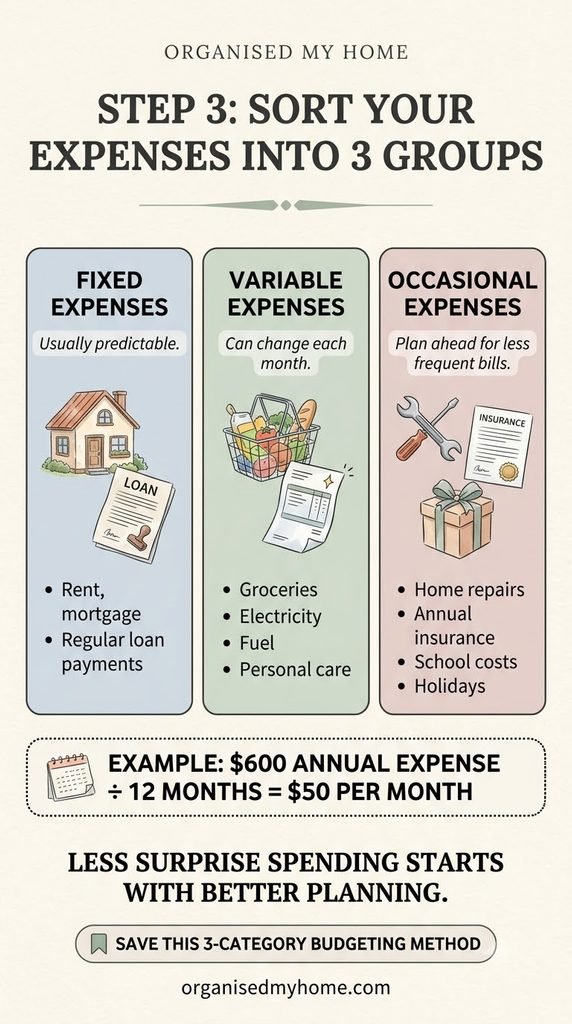
Grouping expenses makes them easier to understand and plan for.
Fixed expenses are generally predictable, such as rent, a mortgage payment, or a regular loan payment.
Variable expenses change according to usage or household needs. Examples include groceries, electricity, gasoline, and personal care.
Occasional expenses happen less frequently but still need attention. These may include annual insurance payments, holiday spending, school costs, car maintenance, and home repairs.
For annual or irregular expenses, look back over previous bills where possible. If you expect a $600 annual expense and have 12 months to prepare, setting aside $50 per month would cover the planned amount, provided your budget can accommodate it.
Add these less frequent costs to your plan instead of treating them as surprises every time they arrive.
Step 4: Create a Realistic Household Spending Plan
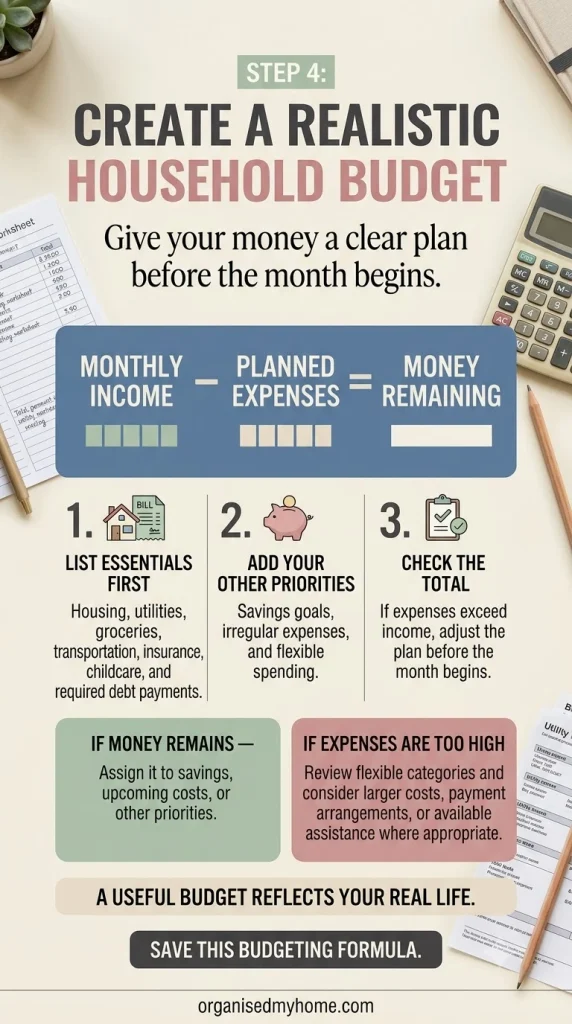
Now compare your monthly take-home income with your expenses.
List essential costs first, including housing, utilities, groceries, transportation, insurance, childcare, and required debt payments. Then add savings goals, occasional expenses, and flexible spending.
Use this simple calculation:
Monthly income − planned expenses = money remaining
If the result is positive, decide how much should go toward savings, upcoming expenses, or other priorities. If the result is negative, your plan needs adjustment before the month begins.
Review flexible categories first, but don’t assume every expense can be reduced. Housing, medical needs, childcare, and transportation may leave little room for change. When the numbers still don’t work, you may need to explore payment arrangements, available assistance, or changes to larger expenses rather than trying to solve everything by cutting small purchases.
Your budget should reflect your real circumstances, not an ideal month that rarely happens.
Step 5: Give Every Important Bill a Due Date
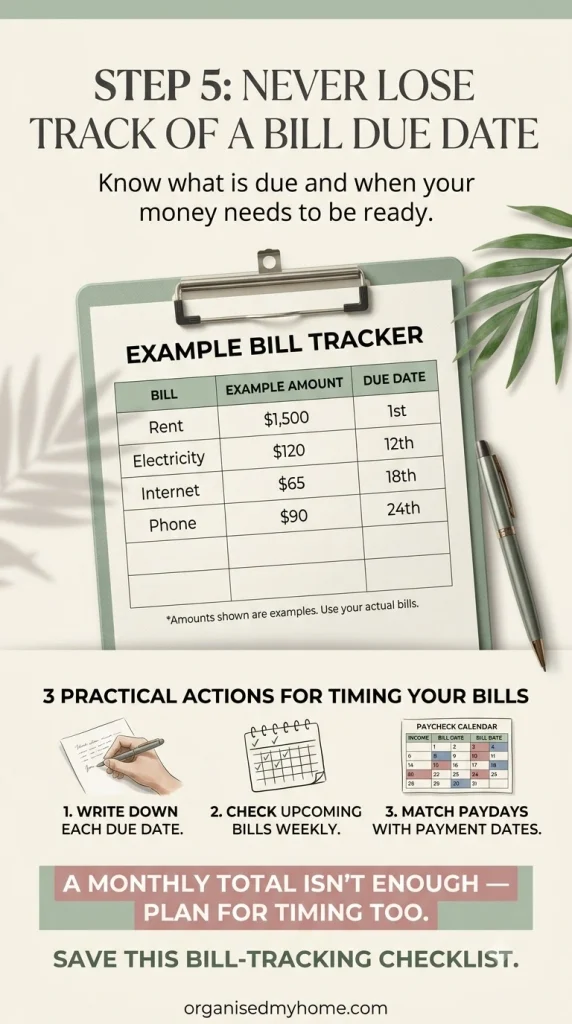
Knowing how much you owe is only part of the process. You also need to know when the money must be available.
Create a bill list with the following information:
| Bill | Amount | Due date | Paid? |
|---|---|---|---|
| Rent or mortgage | $1,500 | 1st | ☐ |
| Electricity | $120 | 12th | ☐ |
| Internet | $65 | 18th | ☐ |
| Phone | $90 | 24th | ☐ |
These amounts are examples only. Replace them with your household’s actual bills.
Add your own payment dates and check them at the beginning of each week. If you’re paid every two weeks, map your income dates alongside your bills so you can see which paycheck needs to cover each expense.
This is particularly useful when the total monthly income appears sufficient but several bills arrive before the next paycheck.
Step 6: Set Spending Limits That Match Your Life
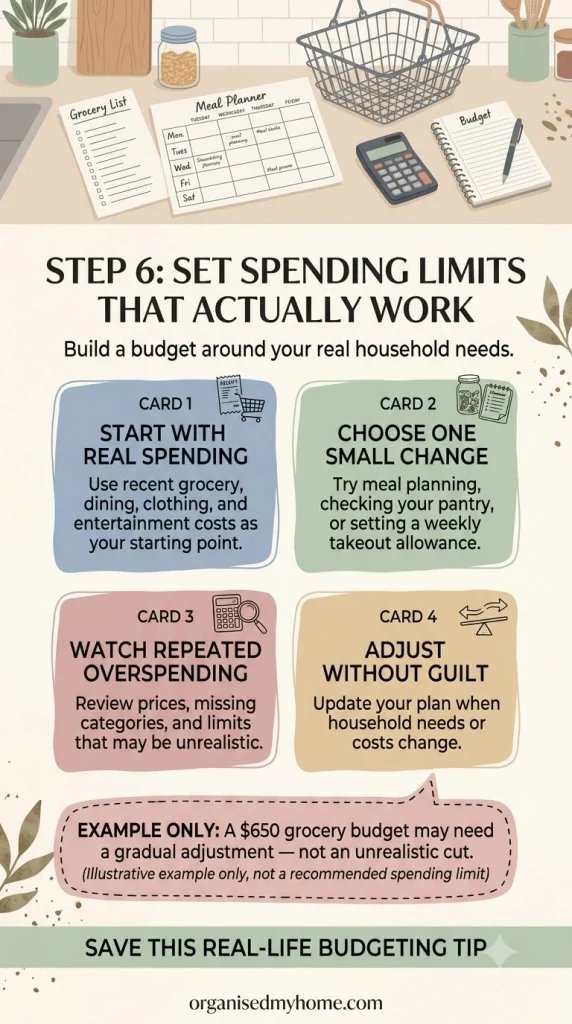
Once essential bills are accounted for, decide how much you can reasonably spend on groceries, eating out, entertainment, clothing, and other flexible categories.
Use your actual spending history to guide these limits. If your family usually spends $650 on groceries, suddenly setting a $300 limit without changing shopping habits or meal plans may create frustration.
Instead, look for one manageable improvement. You might plan meals before shopping, check your pantry, compare unit prices, or set a weekly takeout allowance.
If a category repeatedly goes over budget, investigate why. The amount may be unrealistic, prices may have increased, or another expense may belong in that category. Adjust the plan based on what you learn.
A useful budget is one you can revisit honestly, not one that makes you feel guilty every time life changes.
Step 7: Use Your Home Budget Planner Printable PDF
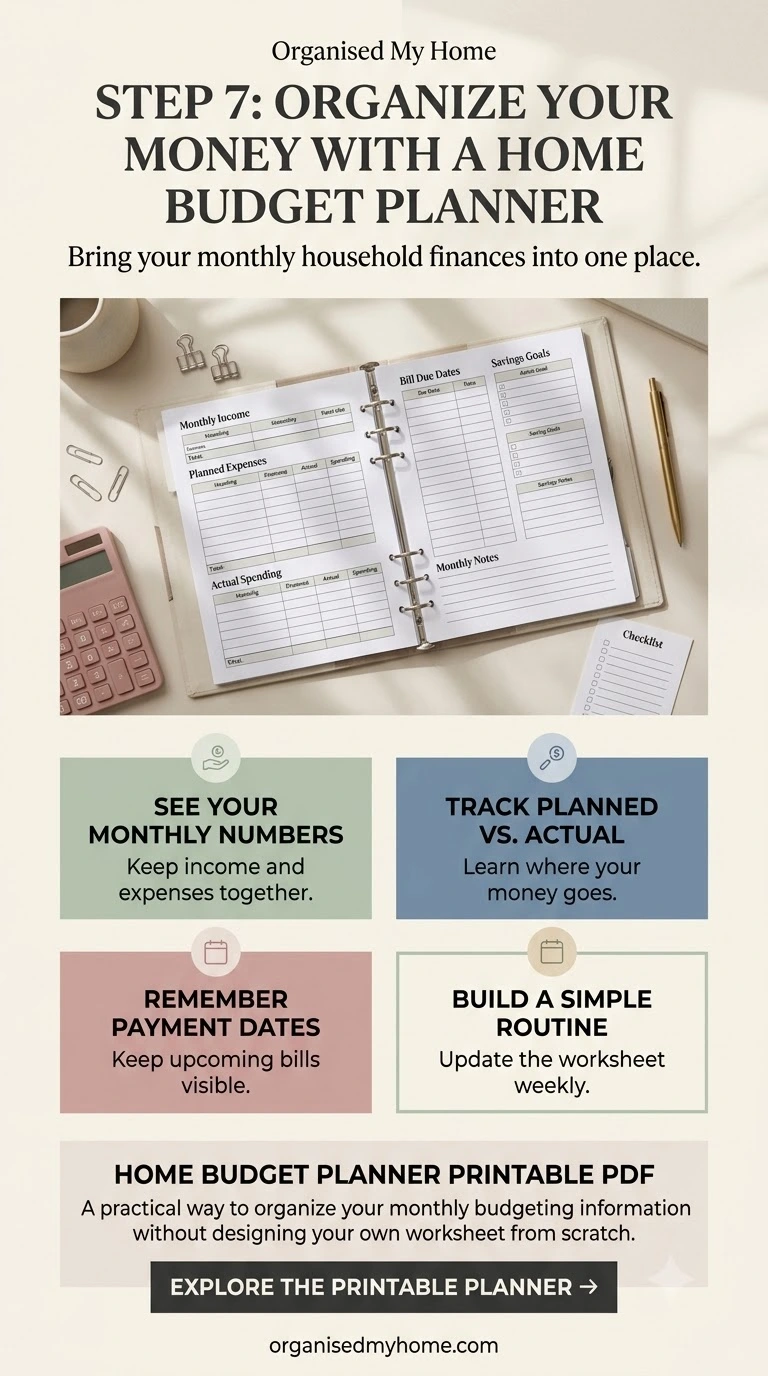
Once you understand your income and expenses, transfer the information into your printable planner.
Keep the current month’s figures together, including planned spending, actual expenses, payment dates, and any savings targets your planner supports. If a category needs extra attention, mark it clearly so you remember to review it.
You can keep the completed pages in a household binder, a dedicated folder, or another private place where you can find them easily.
Try to update the planner as expenses happen, or choose a regular time each week to enter them from your bank statements and receipts. The best method is the one that fits your routine.
If you want a structured starting point, you can explore the Home Budget Planner Printable PDF on the Organised My Home website. It offers a practical way to bring your budgeting information into one place without having to design your own worksheet from scratch.
Step 8: Review Your Budget Every Week
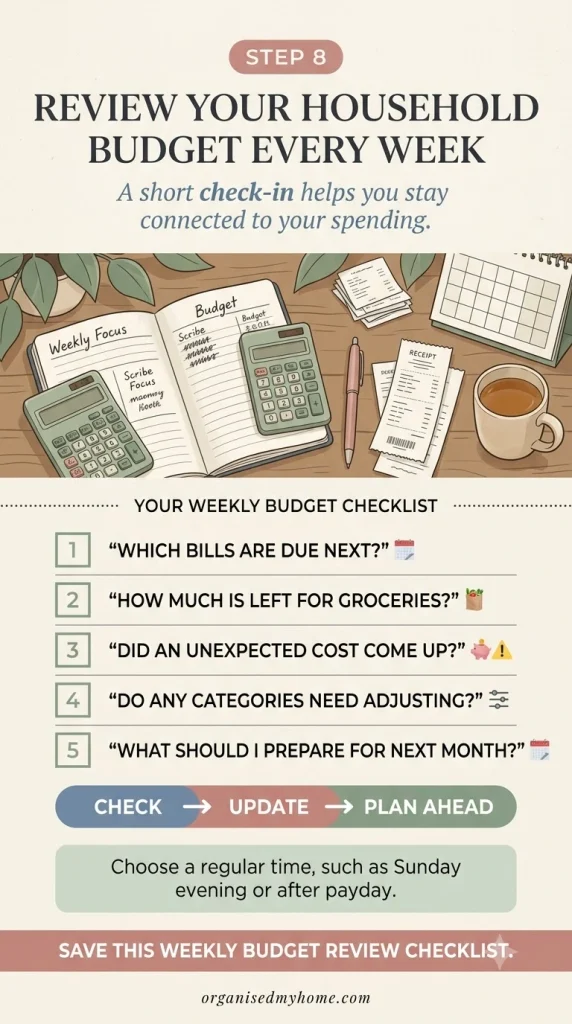
Choose a regular time, perhaps Sunday evening or the day after payday, to review your spending.
Ask yourself:
- Which bills are due before the next review?
- How much remains in my grocery and other flexible categories?
- Did any unexpected expense come up?
- Do I need to move money between categories?
- Is there anything I need to plan for next month?
A short, regular review can make it easier to spot problems before they grow. You don’t need to recalculate everything daily; the aim is to keep your plan connected to reality.
Step 9: Adjust Your Plan at the End of the Month
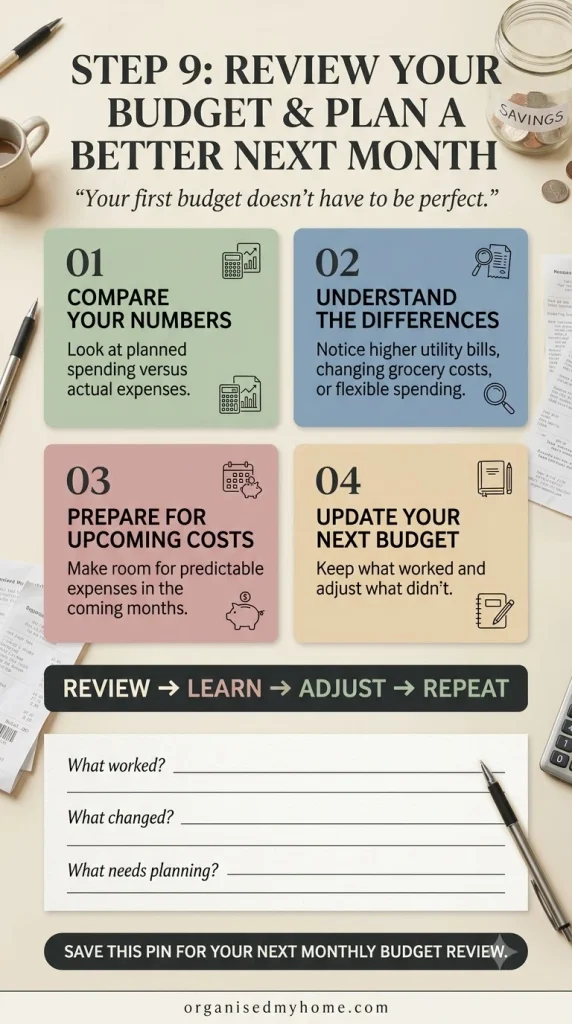
At the end of the month, compare your planned amounts with what you actually spent.
Notice which categories matched your expectations and which ones didn’t. If your utility bill was higher because of seasonal usage, account for that possibility next time. If you spent less on dining out, decide whether that amount can support another priority.
Also, note any expenses that are coming up in the next few months. Preparing for predictable costs gradually may make them easier to manage when the bill arrives.
Your first budget doesn’t have to be perfect. Each review gives you information that can help you make the next version more useful.
What This Can Look Like in Real Life
Imagine a household where two adults share bills, groceries, transportation, and other everyday expenses.
Before using a planner: One person checks the bank balance while the other searches email for the electricity bill. Grocery spending is estimated from memory, and an annual insurance payment catches them off guard. They know they need to save, but they aren’t sure how much is realistically available.
After creating a simple budgeting system: Their income and regular bills are listed on one page. Grocery and transportation spending have their own categories. Annual expenses are divided into monthly savings targets where possible, and payment dates are easy to check.
They still have bills to pay and decisions to make. The difference is that they can see what’s coming, recognize where adjustments may be needed, and discuss their priorities using the same information.
That’s the real value of a budget planner: it makes the next decision clearer.
Benefits of Using a Printable Home Budget Planner
A printable budget planner is a simple tool, but it can support several useful habits when you use it consistently.
- Keeps information together: You can find your income, expenses, and payment dates without searching through scattered notes.
- Makes spending easier to see: Written categories help you compare planned amounts with actual spending.
- Encourages regular check-ins: A visible worksheet can remind you to review your budget before the month gets away from you.
- Breaks budgeting into smaller steps: Instead of tackling every financial task at once, you can focus on income, bills, spending, and savings one section at a time.
- Reduces mental clutter: You don’t have to remember every figure or upcoming expense in your head.
- Fits different routines: You can update your pages weekly, after payday, or whenever you review your finances.
- Can save time: A ready-made layout means less time spent designing your own tracking system.
A printable works best when you make it part of a routine. Keeping an untouched worksheet in a drawer won’t change your finances, but using it for a short weekly review may make it easier to stay aware of your spending.
Why Choose an Organised My Home Printable?
Organised My Home creates practical printable resources for people who want everyday responsibilities to feel more manageable. The idea is straightforward: give important information a clear place so you can spend less time organizing the system and more time using it.
The Home Budget Planner Printable PDF can be a helpful starting point if you want a ready-made way to organize household expenses. You can use a printable alongside your bank statements and existing financial records, without needing to replace the tools you already prefer.
Budget-Friendly and Practical
A budget planner should support your financial goals without adding an unnecessary expense. Organised My Home offers printable resources designed to be accessible and practical, so you can choose a tool that fits your needs and budget.
Before purchasing any printable, review the product details and price to make sure it includes the pages and features you want. A simple worksheet that you actually use can be more helpful than a complicated system that feels difficult to maintain.
An All-in-One, Ready-to-Use Starting Point
Creating a budget from scratch can mean deciding which categories to include, how to arrange the figures, and where to record progress. A ready-made printable gives you a starting structure.
You can fill in the information that applies to your household, leave irrelevant categories blank, and add notes wherever needed. The goal is to keep the process straightforward rather than create more paperwork.
US Letter and A4 Printing Options
Organised My Home printable products are designed with both US Letter and A4 paper sizes in mind. US Letter is the standard choice for most home printers in the United States, while A4 may be useful if you use a printer or print service that supports that format.
Choose the appropriate file for your paper size, check the print settings, and preview the page before printing. You can print at home or use a local print service if that’s more convenient. Print the pages you need when you need them, and keep completed sheets somewhere private.
Free Printables From Organised My Home
You don’t have to purchase a product to begin building better household routines. Organised My Home also offers a limited selection of free printables, giving readers an opportunity to try simple organization tools without paying for every resource.
Browse the website’s free printable selection to see what’s currently available. If you find a tool that fits your needs, start there and build your routine gradually, Download Free Monthly Home Budget Planner Printable PDF
Whether you use a free worksheet or choose a paid planner, the important thing is to have a system you can understand and maintain.
Make Your Household Budget Easier to Manage
You can start today with three small actions:
- Gather your latest bills and income records.
- Write down your main monthly expenses and their due dates.
- Choose a regular time each week to review your spending.
Once you have a clearer picture of your finances, you can decide whether a more structured worksheet would make the process easier.
If you’d prefer a ready-made starting point, explore the Home Budget Planner Printable PDF at Organised My Home. You can also browse the website’s limited free printables to find an option that suits your current needs.
For additional household organization ideas, consider these related topics as you build your routines:
Explore More: How Do I Keep Track of Monthly Household Expenses? Paycheck Budget Planner
Add links to these anchor texts when the corresponding articles are available on your website.
Conclusion
Managing household expenses doesn’t mean tracking every penny perfectly or giving up everything you enjoy. It means understanding what comes in, knowing what needs to go out, and making thoughtful decisions with the money available to you.
A simple Home Budget Planner can help you organize bills, plan everyday spending, prepare for less frequent expenses, and review your progress without relying entirely on memory. Start with the information you already have, make a realistic plan, and adjust it as your household’s needs change.
At Organised My Home, Prince Mali shares practical ideas and printable tools to make everyday home responsibilities easier to manage. If a ready-made worksheet would help you organize your finances, explore the Home Budget Planner Printable PDF. If you’d rather begin without purchasing anything, take a look at the limited free printables available on the website.
You don’t need a perfect budget to make progress. You just need a clear place to begin and a simple system you can return to each month.