Cleaning your entire house can sometimes feel like a job that never really ends. You clean the kitchen, then the laundry piles up. You vacuum the floors, then the bathroom needs attention. By the time you finish one room, another seems to need cleaning.
The solution usually isn’t cleaning more. It is having a simple system that tells you what to clean, when to clean it, and what can wait.
A practical Weekly Home Cleaning routine can help break housework into smaller, manageable tasks instead of leaving everything for one exhausting cleaning day.
And you don’t need to make your home spotless every day. The CDC recommends regularly cleaning frequently touched surfaces and cleaning other surfaces when they are visibly dirty or as needed. In most household situations, routine cleaning with soap or detergent is enough; disinfecting is generally more relevant when someone is sick or has recently been sick.
Pinterest also has a large collection of weekly cleaning routines, schedules and printable checklists, showing how popular the idea of organizing cleaning into a repeatable routine has become.
So, how can you create a Weekly Home Cleaning routine without feeling overwhelmed?
Let’s make it simple.
Why Does Weekly Home Cleaning Feel So Overwhelming?
One of the biggest problems with housework is that we often look at the whole house at once.
You see dusty furniture, a messy kitchen, laundry, bathrooms, floors, bedrooms and clutter—and suddenly cleaning feels like a huge project.
But you don’t actually need to solve every problem at the same time.
A better approach is to divide your home into small cleaning categories and give yourself a realistic amount of work each day.
For example:
- Monday: Bedrooms
- Tuesday: Bathrooms
- Wednesday: Kitchen
- Thursday: Living areas
- Friday: Floors and laundry
- Saturday: Catch-up cleaning
- Sunday: Light reset
This doesn’t mean you must follow these exact days. Your schedule should fit your household, work schedule and lifestyle.
The important idea is to stop thinking:
“I need to clean my entire house.”
Instead, think:
“What are the few things that need attention today?”
That small mental change can make housework feel much more manageable.
How to Clean Your House Weekly Without Feeling Overwhelmed
Step 1: Start With a Simple Weekly Cleaning Plan
Before grabbing a mop or cleaning spray, spend a few minutes planning.
Write down the rooms and recurring tasks that matter most in your home.
A basic weekly list might include:
Kitchen
- Wipe countertops
- Clean the sink
- Wipe appliance surfaces
- Clean the stovetop
- Check the refrigerator for old food
- Sweep or vacuum the floor
- Mop when needed
Bathrooms
- Clean sinks
- Wipe mirrors
- Clean toilets
- Clean showers or tubs
- Wipe frequently touched surfaces
- Sweep and mop floors
- Replace towels
Bedrooms
- Change bedding
- Dust furniture
- Vacuum or clean floors
- Empty trash
- Put away clothing and clutter
Living Areas
- Dust surfaces
- Vacuum upholstery when appropriate
- Straighten cushions
- Clean floors
- Remove clutter
- Wipe frequently touched surfaces
You don’t necessarily need to complete every task every week. Some jobs depend on how many people live in your home, pets, cooking habits and how quickly an area becomes dirty.
Step 2: Use the “One Room at a Time” Method
If your house feels messy, trying to clean everything simultaneously can quickly become frustrating.
Instead, choose one room.
Start at one side of the room and work your way around.
For example:
Bedroom → Bathroom → Kitchen → Living Room → Floors
This gives you a visible sense of progress.
There’s also a practical reason for having a plan: when you already know what comes next, you spend less time deciding what to do.
That’s one reason a Weekly Home Cleaning Checklist Printable PDF can be useful. Instead of keeping the entire cleaning routine in your head, you have one place to look at your tasks.
Step 3: Declutter Before You Deep Clean
Don’t try to dust around piles of objects.
First, put things back where they belong.
Keep a basket or small container nearby for items that have migrated to the wrong room.
For example:
- Toys → toy area
- Clothes → closet or laundry
- Books → bookshelf
- Cups → kitchen
- Mail → designated paper area
- Random items → their proper storage location
Once the surfaces are clearer, cleaning becomes much faster.
A useful rule is:
Clear → Clean → Reset.
You don’t need to organize every drawer or closet during your weekly cleaning session. Save those larger organizing projects for another time.
Step 4: Clean From Top to Bottom
This is one of the simplest ways to make cleaning more efficient.
Start with higher surfaces and work downward.
For example:
Shelves → Tables → Counters → Furniture → Floors
Why?
Because dust and debris can fall onto lower surfaces while you’re cleaning.
If you vacuum first and then dust a shelf, you may end up needing to clean the floor again.
A top-to-bottom approach helps you avoid repeating the same work.
Step 5: Give Your Kitchen a Weekly Reset
The kitchen can easily become the busiest room in the house.
Instead of waiting until it looks completely messy, give it a regular weekly reset.
Start with the countertops.
Then:
- Put away items that don’t belong.
- Clean the countertops.
- Clean the sink.
- Wipe the stovetop.
- Wipe appliance exteriors as appropriate.
- Check the refrigerator for expired or unwanted food.
- Sweep or vacuum the floor.
- Mop when necessary.
Pay particular attention to surfaces that are touched frequently.
The CDC recommends regularly cleaning high-touch surfaces such as countertops, handles, light switches and doorknobs, while other surfaces can generally be cleaned when visibly dirty or as needed.
Step 6: Give Your Bathrooms Focused Attention
Bathrooms don’t need to become an all-day project.
Work in a consistent order.
Quick bathroom routine:
1. Clear the counter
Put toiletries and other items away.
2. Clean the mirror
Use an appropriate glass or mirror cleaner.
3. Clean the sink
Remove visible dirt and residue.
4. Clean the toilet
Follow the instructions for your cleaning product and the manufacturer’s recommendations where applicable.
5. Clean the shower or tub
Focus on areas that are visibly dirty or have accumulated residue.
6. Finish with the floor
Sweep or vacuum first, then mop as appropriate.
Cleaning frequently touched bathroom surfaces regularly is also consistent with CDC household cleaning guidance.
Step 7: Don’t Forget Bedrooms
Bedrooms often don’t need as much cleaning as kitchens or bathrooms, but they can quickly feel untidy because of clothing and everyday clutter.
Your weekly bedroom routine can include:
- Changing or washing bedding according to your household routine
- Dusting accessible surfaces
- Putting clothes away
- Emptying trash
- Cleaning mirrors
- Vacuuming or cleaning floors
- Straightening bedside areas
The goal isn’t to make the bedroom look like a hotel room.
The goal is to make it feel fresh, comfortable and ready for the week ahead.
Step 8: Finish With Floors
Floors are one of the easiest things to leave until the end.
Once you’ve finished dusting and cleaning surfaces, clean the floors according to the flooring manufacturer’s recommendations.
Depending on your home, that could mean:
- Vacuuming carpets
- Vacuuming rugs
- Sweeping hard floors
- Mopping suitable surfaces
- Cleaning visible spills promptly
The CDC recommends using cleaning products appropriate for the specific surface and following product-label instructions.
You don’t need to treat every floor in your home exactly the same way.
Step 9: Use a Weekly Home Cleaning Checklist
This is where a printable can make the routine much easier.
Instead of remembering:
“Did I clean the bathroom?”
“Did I change the bedding?”
“Did I vacuum upstairs?”
“Did I clean the kitchen?”
you can simply check each task as you complete it.
A Weekly Home Cleaning Checklist Printable PDF can turn an overwhelming cleaning routine into a simple visual plan.
You can keep it:
- On the refrigerator
- Inside a cleaning binder
- On a clipboard
- In your home office
- Near your cleaning supplies
The goal isn’t to create more work.
It’s to remove the mental work of remembering everything.
Pinterest currently includes many examples of weekly cleaning schedules and printable checklists, including weekly home reset routines and household cleaning schedules.
A Simple 7-Day Weekly Home Cleaning Routine
Here’s an example you can adapt to your household.
| Day | Main Focus | Example Tasks |
|---|---|---|
| Monday | Bedrooms | Bedding, dusting, floors, clutter |
| Tuesday | Bathrooms | Sinks, mirrors, toilets, shower/tub, floors |
| Wednesday | Kitchen | Counters, sink, stovetop, appliances, floor |
| Thursday | Living Areas | Dusting, clutter, furniture, floors |
| Friday | Laundry & Floors | Laundry, vacuuming, mopping |
| Saturday | Catch-Up | Finish anything missed during the week |
| Sunday | Home Reset | Light tidying and preparation for the week |
This is only a framework—not a rule.
If Saturday is your busiest day, move the larger tasks to another day. If you prefer cleaning everything on one day, combine the tasks.
Your cleaning schedule should work for your life—not the other way around.
How a Printable Weekly Cleaning Checklist Can Help
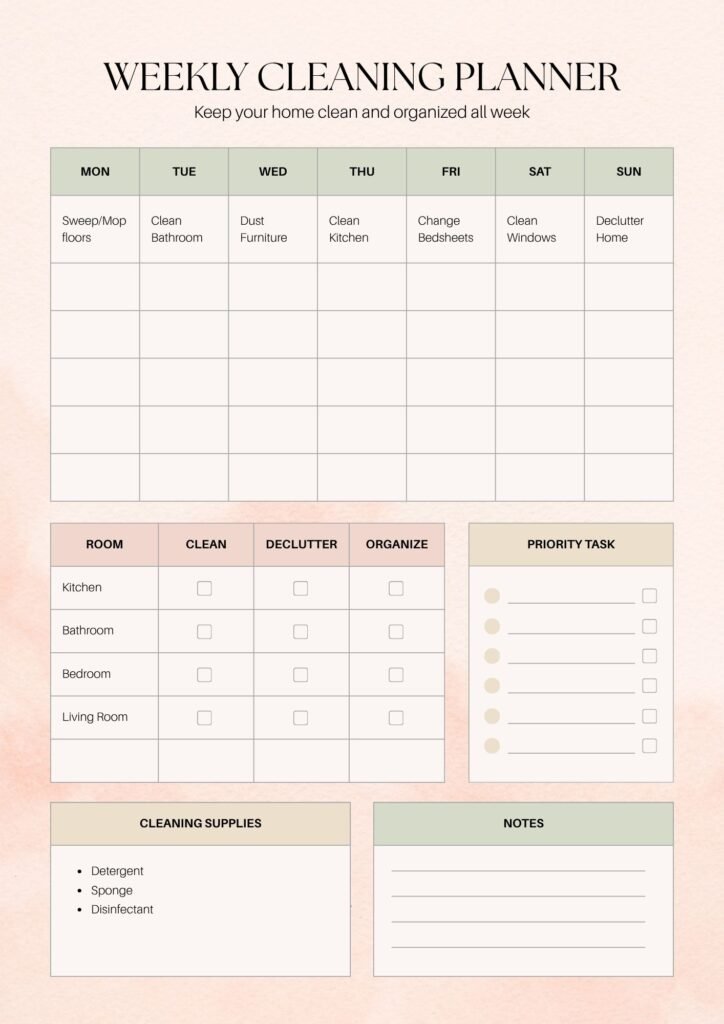
A good printable checklist can be surprisingly helpful because it gives your cleaning routine a physical structure.
1. It Reduces Decision Fatigue
You don’t have to decide what to clean every time you start.
2. It Helps You See Progress
Checking off completed tasks creates a clear visual record of what you’ve accomplished.
3. It Keeps Small Tasks From Being Forgotten
Things such as wiping switches, changing bedding or cleaning appliance surfaces can easily disappear from your mental to-do list.
4. It Makes Cleaning Easier to Share
If multiple family members help with housework, a checklist makes it easier to divide responsibilities.
5. It Creates a Repeatable Routine
After several weeks, your cleaning schedule can become a normal part of your household rhythm rather than a large project you have to rethink every weekend.
Don’t Try to Make Every Week a Deep-Cleaning Week
This is an important distinction.
Weekly cleaning and deep cleaning aren’t the same thing.
Weekly cleaning is about maintaining your home:
- Removing everyday dirt
- Cleaning commonly used areas
- Managing clutter
- Cleaning floors
- Refreshing bathrooms
- Resetting the kitchen
- Keeping laundry under control
Deep cleaning can involve more occasional tasks such as detailed appliance cleaning, washing certain hard-to-reach areas or tackling neglected spaces.
Trying to deep clean the entire house every week is one reason cleaning can become exhausting.
A more sustainable approach is:
Weekly maintenance + occasional deep cleaning.
What If You Miss a Day?
Don’t start over.
This is probably one of the most important rules for building a sustainable Weekly Home Cleaning routine.
If you miss Tuesday’s bathroom cleaning because work ran late, don’t decide that the entire week’s schedule has failed.
Move it to Wednesday or add it to your catch-up day.
Your checklist is a tool—not a test.
A realistic cleaning routine should leave room for:
- Busy workdays
- Family commitments
- Travel
- Unexpected appointments
- Guests
- Rest days
The purpose is to make your home easier to manage, not to give you another source of pressure.
Make Your Weekly Cleaning Routine Easier
A few simple habits can make the entire process feel lighter.
Keep Cleaning Supplies Together
Store commonly used supplies in an organized location so you don’t waste time searching for them.
Clean as You Go
If you spill something, clean it when practical rather than allowing it to become another weekend task.
Use a Timer
A short, focused cleaning session can feel easier than telling yourself you need to clean for hours.
Ask for Help
If you share your home with family members, cleaning doesn’t have to be one person’s responsibility.
Don’t Chase Perfection
A home that is consistently maintained is more realistic than a home that is perfectly spotless every day.
Weekly Home Cleaning: A Simple Mindset Shift
The biggest change isn’t buying more cleaning products or spending your entire Saturday cleaning.
It’s creating a system.
When you have a clear Weekly Home Cleaning routine, you can look at your home and know:
What needs to be done today.
What can wait until tomorrow.
What doesn’t need to be cleaned yet.
That distinction can make a surprisingly big difference.
A printable checklist helps because your cleaning routine becomes something you can see, follow and repeat, rather than another long list living in your head.
Conclusion: Make Cleaning Manageable, Not Perfect
A clean home doesn’t require you to spend every free moment doing housework.
The most sustainable approach is to divide your cleaning into manageable tasks, focus on the areas that actually need attention, and repeat the routine each week.
Start small.
Choose your priority rooms. Divide the work across the week. Clean from top to bottom. Keep clutter under control. Give high-touch surfaces regular attention, and don’t turn every weekly cleaning session into a deep-cleaning marathon. CDC guidance also emphasizes that routine cleaning is generally sufficient in many household situations, with additional disinfection depending on circumstances such as illness.
And if you find yourself constantly wondering “What should I clean today?”, a Weekly Home Cleaning Checklist Printable PDF can give you a simple visual roadmap.
Instead of trying to remember everything, you can simply look, clean, check it off and move on with your day.
Because the goal of a good cleaning routine isn’t a perfect house.
It’s a home that feels comfortable, manageable and easier to enjoy.