Have you ever looked around your house, noticed dishes in the sink, laundry piling up, clutter covering the counters, and a floor that desperately needs attention—and felt completely stuck about where to begin?
You might want a clean home, but deciding what to tackle first can feel like a job in itself. You start picking up a few things, notice another mess, move to a different room, and suddenly find yourself surrounded by half-finished tasks. Before you know it, you’re exhausted, but the house still doesn’t feel clean.
If you have ADHD, resetting a messy house can come with additional challenges. Getting started, estimating how long a task will take, remembering what you were doing, and staying focused can all feel difficult. A traditional cleaning routine that works for someone else might not fit the way you manage everyday responsibilities.
The good news? You don’t have to clean your entire house in one day or wait until you feel motivated enough to tackle everything. A simple, flexible plan can help you identify what matters most, break cleaning into manageable actions, and make progress without expecting perfection.
I’m Prince Mali, the blogger behind Organised My Home. I share practical ideas and simple organization systems designed to make everyday household responsibilities easier to manage. One tool that may help is an ADHD Cleaning Planner, which gives you a visible place to organize cleaning tasks, plan small steps, and keep track of your progress.
Let’s walk through five practical steps to reset a messy house when you have ADHD, including how to use an ADHD Cleaning Planner Printable PDF to make the process easier to follow.
Why Cleaning a Messy House Can Feel So Difficult With ADHD
When several rooms need attention, the challenge isn’t always the physical cleaning. It can also be the number of decisions involved.
Should you wash the dishes first, start a load of laundry, pick up the living room, or clean the bathroom? Each task can lead to another. Putting away laundry might remind you that the bedroom needs tidying, while clearing the kitchen counter reveals paperwork you forgot to handle.
This can make a simple cleaning session feel like dozens of separate jobs.
ADHD affects people differently, but some people experience challenges with executive functions such as planning, prioritizing, organizing, and initiating tasks. These difficulties can make household routines harder to manage, particularly when several responsibilities compete for attention.
A few common cleaning struggles include:
- Not knowing where to start: Every room looks important, so choosing one feels difficult.
- Getting distracted halfway through: You begin cleaning one area but move to another task before finishing.
- Underestimating the work: A quick tidy turns into a much larger job than expected.
- Forgetting unfinished tasks: You remember that you started something but lose track of what remains.
- Feeling overwhelmed by visual clutter: Seeing too many objects and unfinished jobs makes it harder to decide what to do next.
- Expecting too much from yourself: You plan to clean the entire house, run out of energy, and feel disappointed when you can’t finish.
Another common mistake is waiting until you have enough energy to do everything at once. That approach can leave household tasks building up until they feel even more difficult to begin.
Instead of trying to become a person who cleans perfectly every day, focus on building a system that makes the next action obvious.
How an ADHD Cleaning Planner Can Help You Reset Your Home
An ADHD Cleaning Planner is a practical organizational tool that helps you put cleaning tasks into a visible, manageable format.
Rather than relying entirely on memory, you can write down what needs attention, divide larger jobs into smaller steps, and choose a realistic starting point. Depending on the planner pages you use, you can also organize tasks by room, establish daily routines, and mark completed activities.
For example, “clean the kitchen” is a broad instruction that might feel overwhelming. A more manageable list could look like this:
- Throw away visible trash.
- Put dirty dishes in the sink or dishwasher.
- Clear one section of the counter.
- Wipe the cleared surface.
- Sweep the kitchen floor if time and energy allow.
You don’t have to complete every item in one session. Even finishing the first two tasks gives you a clear place to continue later.
The ADHD Cleaning Planner Printable PDF from Organised My Home is designed as a ready-to-use organizational option for people who want a simple visual system for managing household cleaning. You can use a printed planner to keep your priorities visible, follow a routine, and record progress without repeatedly deciding what to do next.
A planner won’t clean the house for you, and it isn’t a treatment for ADHD. However, having tasks written down in one place can reduce the amount of information you need to remember while you’re working.
Explore More: How to Clean Your House with ADHD: Steps with an ADHD Cleaning Planner
How to Reset a Messy House With ADHD in 5 Steps
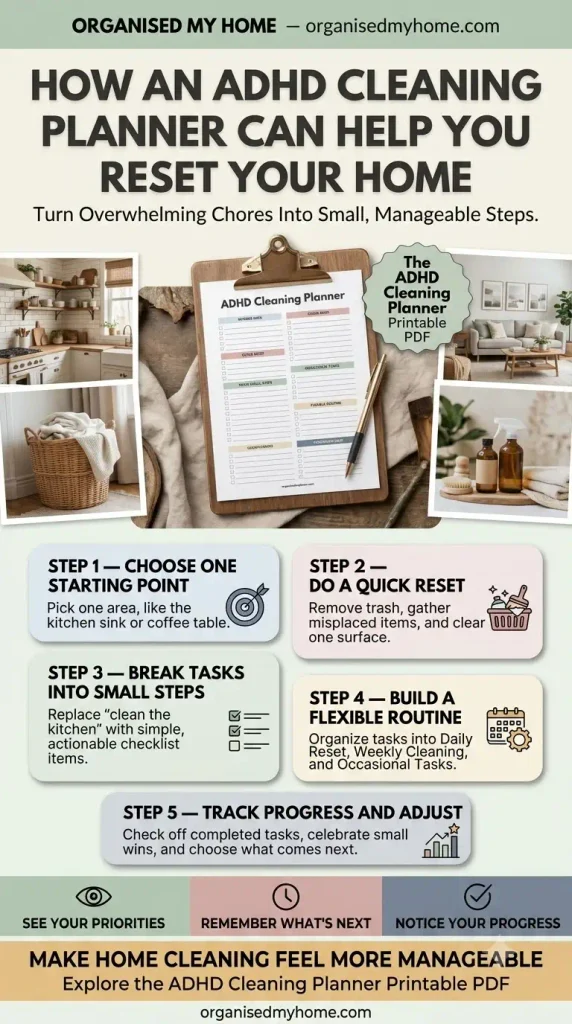
You don’t need to tackle every room or create a complicated cleaning schedule. Start with these five steps and adjust them to fit your home, available time, and energy.
Step 1: Choose One Starting Point Instead of Cleaning Everything
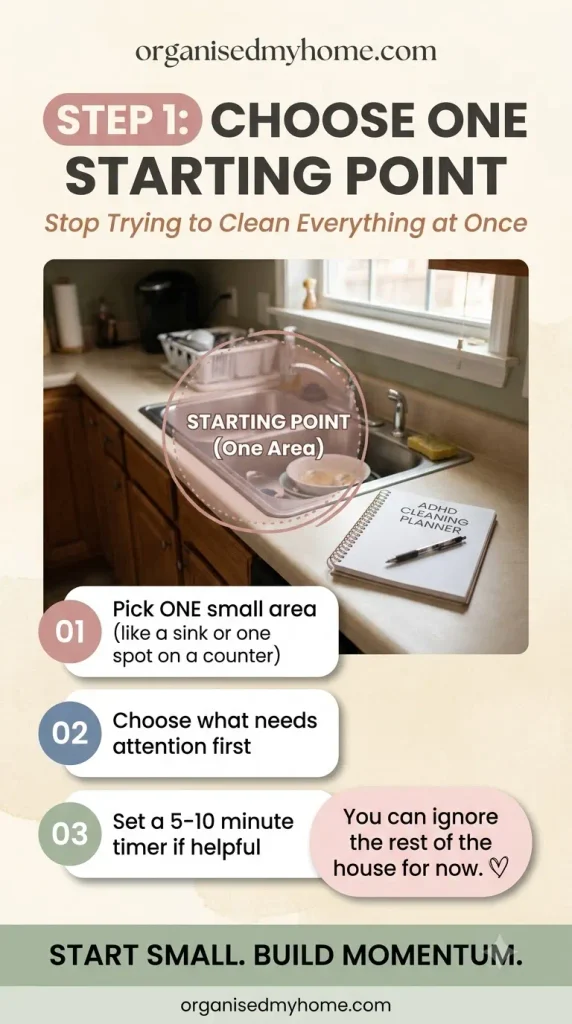
Before picking up a cleaning product, pause and look at the areas that need attention.
It can be tempting to start in the kitchen, move to the bathroom, collect laundry from the bedrooms, and then return to the kitchen. Unfortunately, moving between rooms can create more unfinished tasks and make it harder to see your progress.
Instead, choose one small area.
You might start with the kitchen sink, the living room coffee table, your bedside table, or the entryway where shoes and bags tend to collect.
Ask yourself one simple question: Which small area would make my home feel a little easier to live in right now?
Choose that area and give yourself permission to ignore the rest temporarily.
If the whole house feels overwhelming, try starting with a visible problem that affects your daily routine. Clearing a place to prepare food or making space to sit on the couch can provide a useful starting point.
Try this: Set a timer for five or ten minutes if time limits help you begin. When it rings, you can stop, take a break, or continue if you feel able. The timer is a tool, not a deadline you must meet.
Step 2: Do a Quick Reset Before Deep Cleaning
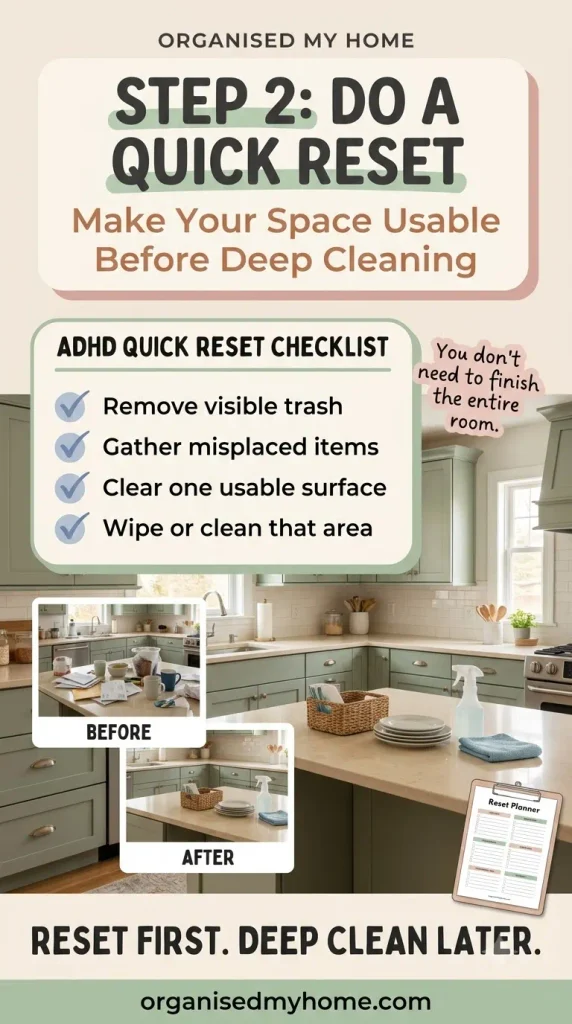
Once you’ve selected your starting area, focus on making it functional rather than perfectly clean.
A quick reset usually works best when you follow a simple order.
First, remove obvious trash. Collect wrappers, empty packaging, junk mail, and other rubbish.
Next, gather misplaced items. Put belongings that belong in the same room together. If something belongs elsewhere, place it in a small basket to return later rather than repeatedly walking from room to room.
Then, clear one usable surface. You don’t have to clear every counter, shelf, or table. Start with the area you use most.
Finally, handle the most important cleaning task. Wipe the cleared counter, wash a few dishes, or vacuum a small section of floor.
Keep the goal modest. You’re creating a usable space, not completing a deep clean.
It also helps to avoid taking everything out of drawers or cupboards during a reset. Organizing a storage space can become a separate project, so save it for another session if necessary.
Step 3: Break Big Cleaning Jobs Into Smaller Actions
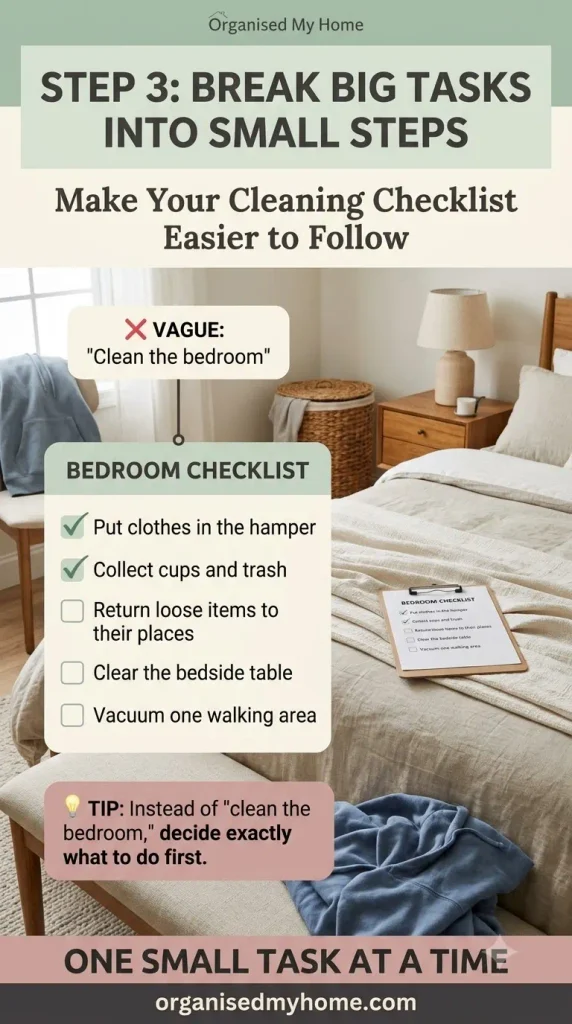
One of the most useful changes you can make is replacing broad instructions with specific actions.
“Clean the bedroom” doesn’t tell you where to start or what finishing looks like. It also leaves plenty of room for distractions.
A short checklist gives you a clearer path.
For example, a bedroom reset might include:
- Put dirty clothes in the laundry hamper.
- Collect cups, plates, and rubbish.
- Put loose items into their usual places.
- Make the bed if that helps the room feel calmer.
- Clear the bedside table.
- Vacuum the most-used walking area.
You can stop after any step and return later. The checklist helps you remember what’s left without requiring you to hold the entire job in your head.
Use the same approach for other rooms.
For the bathroom, you might gather used towels, put toiletries away, wipe the sink, and empty the trash. For the kitchen, you might load the dishwasher, wipe the stove, and clear the table.
Keep your list short enough to feel approachable. If a task still seems too big, divide it again.
For example, instead of “organize the closet,” begin with “put shoes in pairs.” You can deal with the rest another day.
Step 4: Use an ADHD Cleaning Planner to Create a Simple Routine
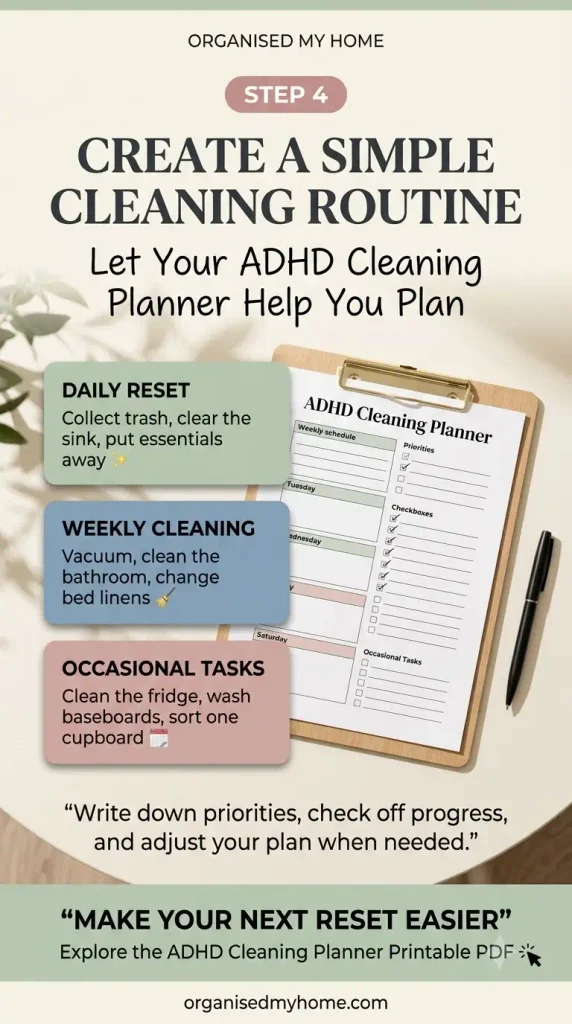
Once you’ve made some progress, decide how you’ll handle cleaning the next time the house starts feeling messy.
This is where an ADHD Cleaning Planner Printable PDF can be particularly useful. Rather than creating a new plan every time you clean, you can keep a repeatable list of the tasks that matter most.
Start with three simple categories:
Daily reset: Small tasks that help your home remain functional, such as collecting trash, clearing the kitchen sink, or putting frequently used items away.
Weekly cleaning: Tasks that need attention regularly, such as cleaning the bathroom, changing bed linens, vacuuming, or washing towels.
Occasional tasks: Less frequent jobs, such as cleaning inside the refrigerator, washing baseboards, or sorting a cluttered cupboard.
You don’t need to assign a task to every day of the week. Begin with the routines that fit your household and schedule.
For example, you might choose a ten-minute kitchen reset after dinner and a short bathroom-cleaning session on the weekend. If that schedule doesn’t work, change it.
When using your planner, keep these tips in mind:
- Write down specific tasks rather than vague goals.
- Choose only a few priorities for each cleaning session.
- Mark tasks as completed so you can see your progress.
- Leave space to add unexpected chores.
- Keep the planner somewhere visible and convenient.
- Review the list when your routine stops working.
The purpose isn’t to create another set of rules to feel guilty about. It’s to give yourself a practical reference point when deciding what needs attention.
Step 5: Check Your Progress and Make the Next Reset Easier
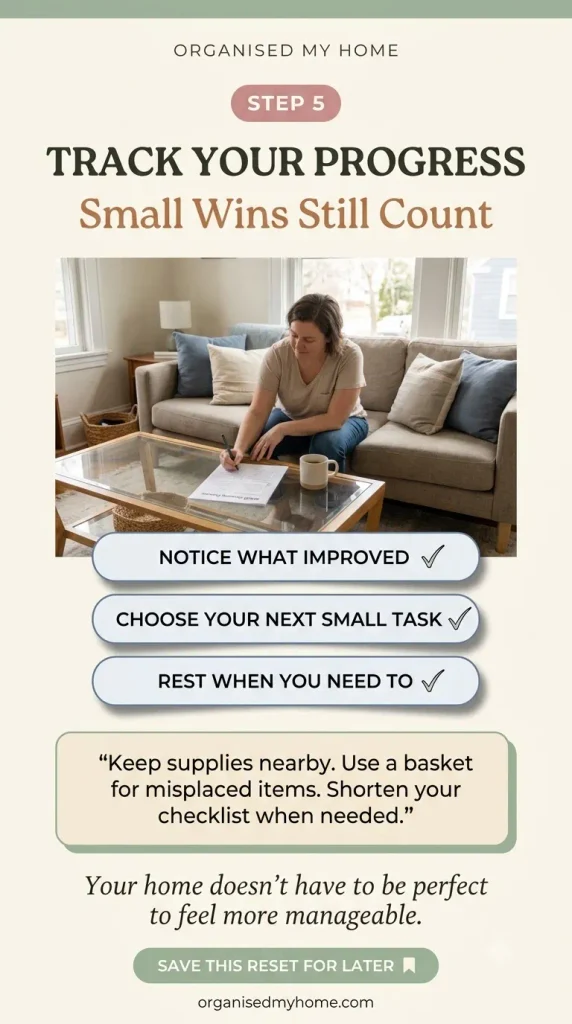
After your cleaning session, take a moment to notice what changed.
You may not have finished the entire room, but perhaps the sink is usable, the laundry is gathered, or the coffee table is clear. Those improvements count.
Look at your remaining tasks and choose a realistic next step. If you have enough energy, continue with another small job. If not, write down where you want to resume and stop for now.
It can also help to identify what made the session easier or harder.
Did you lose time searching for cleaning supplies? Keep frequently used products in a convenient location, following safe storage practices.
Did you get distracted by items that belonged in other rooms? Use a return basket and put everything away in a separate, planned trip.
Did the checklist contain too many tasks? Reduce the list to two or three priorities for your next session.
If a daily routine feels unrealistic, try a less frequent schedule or shorter sessions. Your plan should work with your actual life, not an imaginary version of your day when everything goes perfectly.
Over time, these small adjustments can help you develop a more sustainable household routine.
What This Can Look Like in Real Life
Imagine that you’ve had a busy week. The kitchen counter is covered with mail, the laundry basket is full, there are dishes in the sink, and the living room has accumulated toys, blankets, and everyday belongings.
Before using a simple system:
You walk into the kitchen intending to wash dishes. You notice the mail, begin sorting it, remember the laundry, and head toward the bedroom. There, you start folding clothes but leave the basket half-finished when you notice something else that needs attention.
After an hour, you’ve done several small things, but the house still feels messy. You’re tired and unsure what to tackle next.
After introducing a simple planner:
You look at your cleaning list and choose three priorities: clear the sink, gather the laundry, and remove trash from the living room.
You complete the kitchen task first. Next, you gather the laundry without starting another unrelated project. Finally, you collect the living room trash.
You don’t finish everything, but the sink is usable, the laundry is in one place, and the living room is a little more comfortable.
Before stopping, you mark your completed tasks and note what you want to do next.
The difference isn’t that you suddenly have more motivation or time. You have a clearer plan, fewer decisions to make, and a visible record of what you’ve accomplished.
That is the kind of practical support a cleaning system can offer.
Benefits of Using Printable PDFs for ADHD-Friendly Cleaning
A printable planner won’t suit everyone, but it can be a helpful option if you prefer seeing your tasks on paper rather than switching between phone apps or trying to remember what you planned.
Here are some potential benefits.
1. You Can See Your Priorities at a Glance
A visible checklist makes it easier to identify the next task without reviewing a long list of mental reminders.
You can keep it on a clipboard, in a household binder, or in another convenient place.
2. It Can Reduce Mental Clutter
Writing tasks down gives you somewhere to record unfinished jobs instead of trying to remember them throughout the day.
This may be especially helpful when several household responsibilities are competing for your attention.
3. It Supports Repeatable Routines
When the same basic tasks appear on your checklist each week, you don’t have to rebuild your cleaning plan from scratch.
You can follow the list, make changes when necessary, and gradually develop a routine that fits your household.
4. You Can Track Progress
Checking off completed tasks provides a simple visual record of what you’ve done.
Instead of focusing only on what remains unfinished, you can also see the work you’ve already completed.
5. It Is Flexible and Easy to Reuse
You can print a fresh copy when you need one, write notes directly on the page, and adjust your checklist as your home or schedule changes.
You can also choose to use only the pages that are relevant to your current needs.
6. It May Save Time and Reduce Repeated Decisions
A ready-made list can help you spend less time planning and more time working on a manageable task. The amount of time saved will depend on your home, habits, and how you use the planner, but a clear starting point may make cleaning sessions easier to begin.
Why Choose an Organised My Home ADHD Cleaning Planner Printable PDF?
If you want a structured starting point instead of building a cleaning system from scratch, the ADHD Cleaning Planner Printable PDF from Organised My Home is one option to consider.
It’s intended for people who want a practical, ready-to-use approach to household organization. Rather than relying on memory alone, you can use a printable format to keep cleaning tasks visible and create a routine that feels manageable.
Here are a few practical reasons to consider a printable system.
Budget-Friendly and Practical
Printable PDFs offer a straightforward way to organize household tasks without needing a dedicated electronic device or a new subscription just to view your checklist.
The planner is intended as a budget-friendly organization option. Check the current product listing for its price and included pages so you can decide whether it suits your needs.
A Ready-to-Use Starting Point
Starting with a blank sheet can sometimes create another decision: what should you write down?
A ready-made planner provides a starting structure you can adapt to your home. You can begin with the tasks that are relevant to you and leave out anything that doesn’t fit your routine.
The goal is to make cleaning easier to organize, not to create more paperwork.
US Letter and A4 Printing Options
Paper sizes matter when you’re printing from home or using a print service.
Organised My Home printable products are designed with both US Letter and A4 sizes in mind. US Letter is commonly used in the United States, while A4 is used in many other countries.
Before printing, choose the version that matches your paper size and follow the product’s printing instructions.
Print the Pages You Need
A printable system gives you the flexibility to use the pages that make sense for your current situation.
You might keep a frequently used cleaning checklist nearby, place your weekly routine in a household binder, or print a fresh working copy when your needs change.
You don’t have to use every page at once. Start with what helps, then adjust your system over time.
Free Printables From Organised My Home
You don’t have to purchase a planner to begin organizing your home.
Organised My Home also offers selected free printables to help readers explore simple organization tools without committing to a paid product.
These can be a useful starting point if you want to try writing down household tasks, creating a basic checklist, or establishing a more visible routine before choosing a more structured planner.
Explore the available free printables on Organised My Home and choose an option that fits your current needs. Availability and the specific pages offered may vary, so check the website for the latest selection.
Make Your ADHD Cleaning Routine Work for You
The most helpful cleaning routine is one you can return to without feeling that you have to start over every time life gets busy.
Begin with one area, clear the most important clutter, break larger jobs into smaller actions, and keep your next steps visible. Use your planner as a flexible reference rather than a strict schedule you must follow perfectly.
If you’d like a ready-made starting point, explore the ADHD Cleaning Planner Printable PDF from Organised My Home. You can also browse the available free printables if you’d prefer to begin with a simpler tool.
Final Thoughts: A Messy House Doesn’t Mean You’ve Failed
Resetting a messy house when you have ADHD can feel overwhelming, especially when every room seems to need attention at the same time. But you don’t have to solve everything in one afternoon.
Start with one small area. Give yourself a short, manageable list. Focus on making your home more functional instead of trying to make it perfect. When you finish, record your progress and leave yourself a clear next step.
You may discover that you don’t need a more complicated cleaning routine. You may simply need a system that makes it easier to begin, remember what matters, and return to unfinished tasks.
At Organised My Home, I, Prince Mali, share practical ideas and printable tools to help make everyday home responsibilities easier to manage. Whether you use a handwritten checklist, a free printable, or a dedicated ADHD Cleaning Planner, choose the approach that works best for your household.
Your home doesn’t have to be spotless to feel better. A few small steps, repeated when you can, can help you build a more manageable space—one reset at a time.