
Cleaning your house can feel surprisingly difficult when you have ADHD. You might start by washing the dishes, notice the overflowing laundry basket, walk into the bedroom to grab some clothes, and suddenly find yourself organizing a drawer you hadn’t planned to touch. Meanwhile, the dishes are still waiting.
If this sounds familiar, you’re not alone in finding everyday household responsibilities challenging. The CDC explains that ADHD can affect adults’ ability to manage daily tasks, particularly when demands and stress are high.
The solution isn’t necessarily to work harder, create a stricter schedule, or force yourself to clean the entire house in one afternoon. Sometimes, what helps most is a simpler system that shows you what needs to be done, where to begin, and what you can leave for another day.
I’m Prince Mali, the blogger behind Organised My Home. I share practical ideas and simple systems to help make everyday home responsibilities easier to manage. One tool that can help is an ADHD Cleaning Planner Printable PDF, which gives you a visual way to organize cleaning tasks, break them into smaller steps, and track your progress without relying entirely on memory.
Let’s explore how to clean your house with ADHD using realistic routines that can work with your daily life, energy levels, and available time.
Why Cleaning Can Feel So Overwhelming When You Have ADHD
Cleaning sounds like one simple activity, but it actually involves many smaller decisions.
You need to notice what’s dirty, decide what to clean first, gather supplies, remember the next step, ignore distractions, and keep going until you reach a stopping point. When several rooms need attention, that list of decisions can feel exhausting before you’ve even started.
The CDC notes that ADHD can affect everyday functioning in adults. CHADD, a nonprofit organization focused on ADHD, also recommends making to-do lists specific and breaking larger projects into smaller, actionable tasks.
Here are a few common cleaning challenges you might recognize.
1. You Don’t Know Where to Start
You look around the living room and notice laundry, dishes, dusty furniture, toys, and papers. Everything seems equally urgent, so choosing one task feels difficult.
Instead of writing “clean the living room,” choose one visible action: pick up the clothes, clear the coffee table, or collect the dishes.
A specific first step makes it easier to begin.
2. You Get Distracted Midway Through a Task
You start putting away laundry, discover an item that belongs in another room, and go to return it. On the way, you notice something else that needs attention.
Before long, you’ve started several chores but haven’t finished the original one.
A short checklist can help you return to your original task when your attention shifts.
3. You Underestimate How Much Time Cleaning Takes
You might plan to clean the kitchen, bathroom, bedrooms, and living room in 30 minutes. When that doesn’t happen, the entire day can feel like a failure.
Instead, plan for a small amount of progress. Ten minutes spent clearing kitchen counters is still useful, even if the bathroom remains untouched.
4. You Rely on Memory Instead of a Visible System
You remember to wash towels but forget to change the sheets. You notice the trash is full after you’ve already settled down for the evening. Important household tasks remain scattered across sticky notes, phone reminders, and mental to-do lists.
A single visible cleaning checklist gives those tasks a consistent place to live.
5. You Feel Discouraged When You Miss a Day
Perhaps you follow a cleaning routine for three days and then have a busy week. When you return to it, the checklist feels impossible to catch up on.
The answer isn’t to double your workload the next day. Start again with the most important tasks and let the rest wait.
You don’t need a perfect cleaning streak. You need a routine that’s easy to restart.
How an ADHD Cleaning Planner Can Make Housework Easier
An ADHD Cleaning Planner Printable PDF can help turn a vague goal into a clear, manageable plan.
Instead of thinking, “I need to get the whole house clean,” you can look at a page and choose one task. You can mark it complete, see what remains, and decide whether you have the time and energy to continue.
A useful planner may help you:
- Organize daily and weekly household chores.
- Break larger cleaning projects into smaller actions.
- Keep recurring tasks visible.
- Track completed chores without trying to remember everything.
- Choose priorities when your home feels overwhelming.
- Create a flexible routine that you can return to after a busy day.
- Reduce the number of decisions you need to make before getting started.
A planner won’t clean your home for you, and it won’t automatically remove distractions. Its purpose is to provide a simple visual structure that can make the work easier to understand and manage.
The best system is one you’ll actually use, even on an ordinary, imperfect day.
How to Clean Your House with ADHD Planner: 9 Steps
You don’t have to transform your entire home in a weekend. Start with a small, repeatable approach that makes your next cleaning session easier.
Step 1: Decide What a Clean Enough Home Means to You
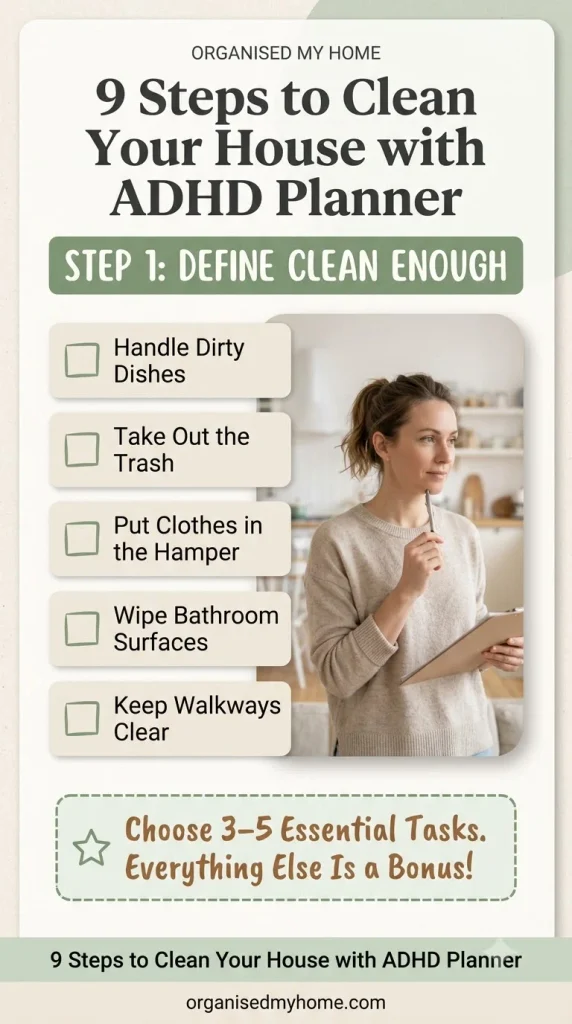
Before creating a cleaning schedule, decide which tasks matter most for your household.
For example, your essential priorities might be:
- Food scraps and dirty dishes are dealt with regularly.
- Trash doesn’t overflow.
- Dirty laundry has a designated place.
- Frequently used bathroom surfaces receive regular attention.
- Walkways remain clear enough to move around safely.
Your priorities may look different depending on whether you live alone, share a home with family, have pets, or work long hours.
Write down three to five essentials. These are your baseline tasks, not a standard you must meet perfectly every day.
Once they’re handled, anything extra is a bonus.
Step 2: Start With One Small Area
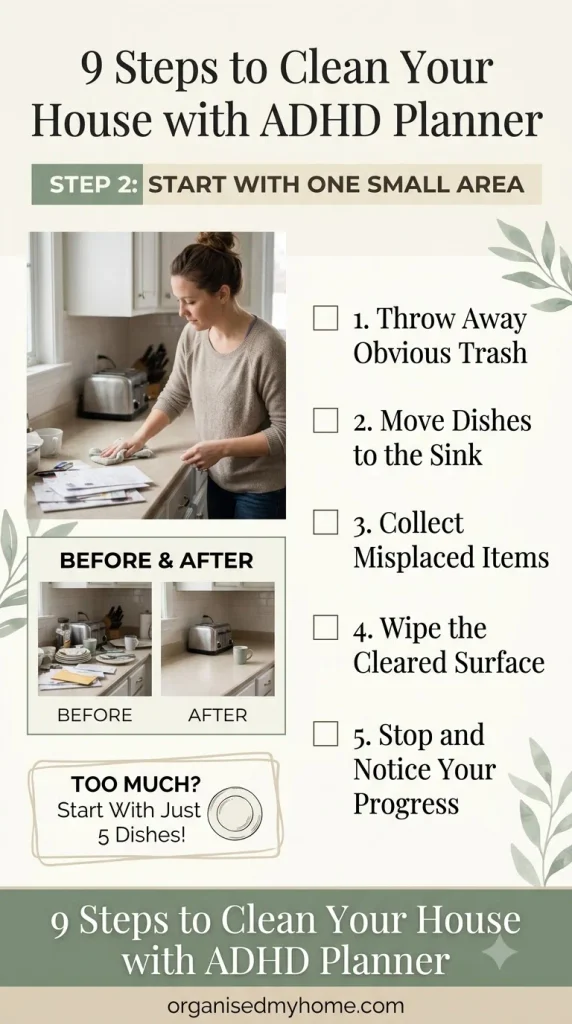
Choose the room or area that’s causing the most immediate frustration.
If the kitchen feels overwhelming, don’t begin by planning the entire house. Focus on one counter or the sink.
Try this simple sequence:
- Throw away obvious trash.
- Move dishes to the sink or dishwasher.
- Put misplaced items in a designated basket.
- Wipe the cleared surface.
- Stop and check your progress.
You don’t need to finish every kitchen chore before moving on. Completing one small area gives you a clear stopping point.
If the task still feels too large, make the starting point smaller. You could begin with just five dishes or one section of the counter.
Step 3: Break Every Big Chore Into Smaller Tasks
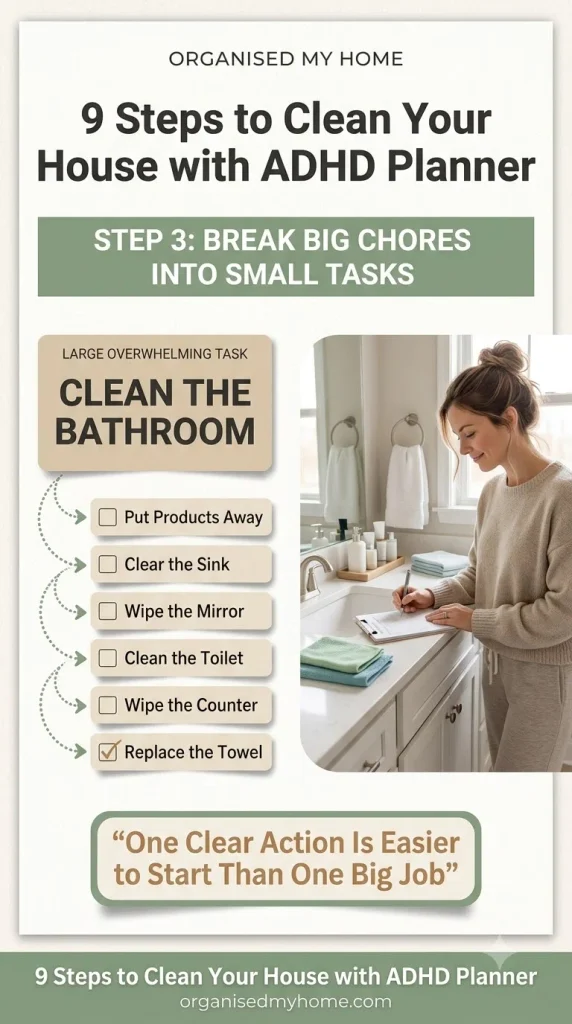
One of the most useful ADHD-friendly cleaning strategies is replacing broad instructions with specific actions.
“Clean the bathroom” doesn’t tell you where to begin. A short list does.
Step 4: Use Short Cleaning Sessions

You don’t need to wait until you have an entire free afternoon to clean.
Choose a short time window, such as 5, 10, or 15 minutes. Set a timer if that helps you stay focused, then work on one defined task until the timer ends.
For example, a 10-minute kitchen reset might include putting away clean dishes, loading dirty dishes, and wiping the counters.
When the timer goes off, you can stop. If you feel comfortable continuing, choose another small task.
Short sessions are especially useful on busy days because they give cleaning a clear beginning and end. CHADD also recommends using timers and dividing larger projects into smaller work periods as possible ways to manage tasks.
Step 5: Create a Flexible Weekly Cleaning Routine
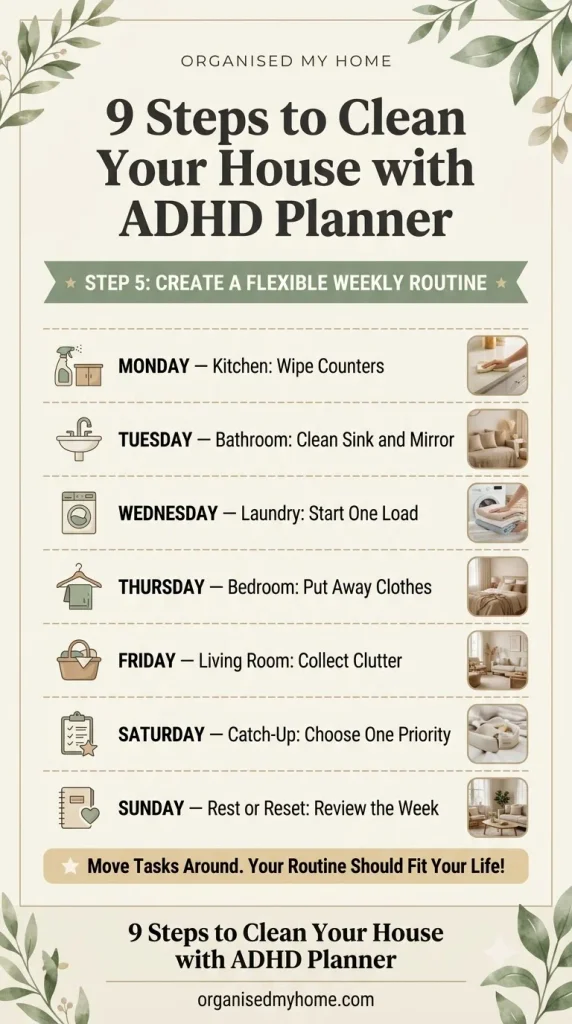
A weekly routine can reduce the need to decide what to clean every morning.
Instead of assigning yourself a long list for every day, choose one main area and a few essential tasks.
Here’s an example you can adjust to your home:
| Day | Main focus | Simple starting task |
|---|---|---|
| Monday | Kitchen | Clear and wipe counters |
| Tuesday | Bathroom | Clean the sink and mirror |
| Wednesday | Laundry | Start one load |
| Thursday | Bedrooms | Put away clothes and clear surfaces |
| Friday | Living room | Collect clutter and tidy seating |
| Saturday | Catch-up | Choose one unfinished priority |
| Sunday | Rest or reset | Check the coming week’s needs |
This is an example, not a rule. You can move tasks to different days, combine areas, or skip nonessential chores when life gets busy.
If daily themes don’t suit you, try a simple rotating list instead. The important part is having a starting point when you’re unsure what to do.
Step 6: Make Your Cleaning Supplies Easy to Find

Sometimes the hardest part of cleaning is getting everything ready.
If your cleaning cloths are in one cabinet, the spray is in another room, and the vacuum is tucked behind several boxes, starting can feel like a project in itself.
Keep commonly used supplies together where they’re practical and safe to store. A small cleaning caddy can make it easier to move between rooms.
You can also place a laundry basket in the area where clothes tend to accumulate or keep a small catch-all basket for items that belong elsewhere.
Choose storage that makes your belongings easy to identify and return. Keep cleaning chemicals safely stored away from children and pets, and follow product label instructions.
Step 7: Use an ADHD Cleaning Planner to Keep Everything Together

This is where a printable cleaning planner can become useful.
Rather than writing a new schedule every week, use your ADHD Cleaning Planner Printable PDF as a central place for your routine.
You could use it to record:
- Your most important daily cleaning tasks.
- Weekly chores by room.
- Tasks you frequently forget.
- Small steps for jobs that feel overwhelming.
- Completed tasks and anything that needs to be rescheduled.
Print the pages you need and put them somewhere you’ll naturally see them, such as a home command center, a kitchen noticeboard, or a binder near your household supplies.
Keep a pen beside the planner. Crossing off completed tasks provides a clear record of what you’ve done, even when the rest of the house isn’t finished.
If paper tends to disappear in your home, a digital checklist or a visible whiteboard may work better. The goal is to make your system accessible, not to force yourself to use a particular format.
Step 8: Make Room for Low-Energy Days
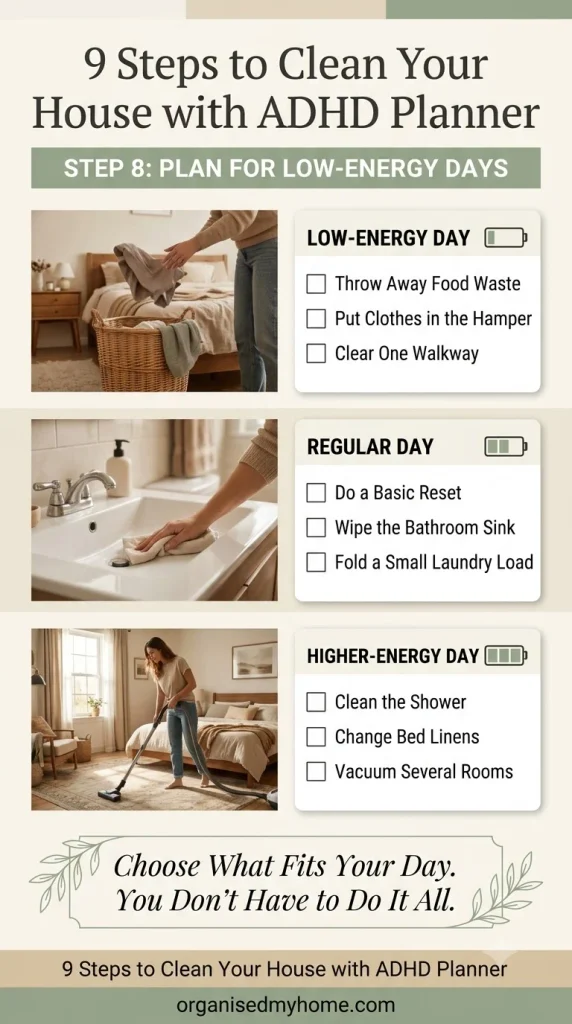
Some days, you may have enough time and energy to clean several rooms. On others, even starting the laundry can feel like a lot.
Plan for both situations.
Low-energy day
Choose one or two essentials: throw away food waste, put dirty clothes in the hamper, or clear a walkway.
Regular day
Complete your basic reset and one room-specific task, such as wiping the bathroom sink or folding a small laundry load.
Higher-energy day
Add a larger job, such as cleaning the shower, changing bed linens, or vacuuming several rooms.
You don’t have to complete every category. Choose the one that matches your day.
This flexible approach can help you avoid turning a missed cleaning session into an overwhelming catch-up list.
Step 9: Review Your Plan Once a Week
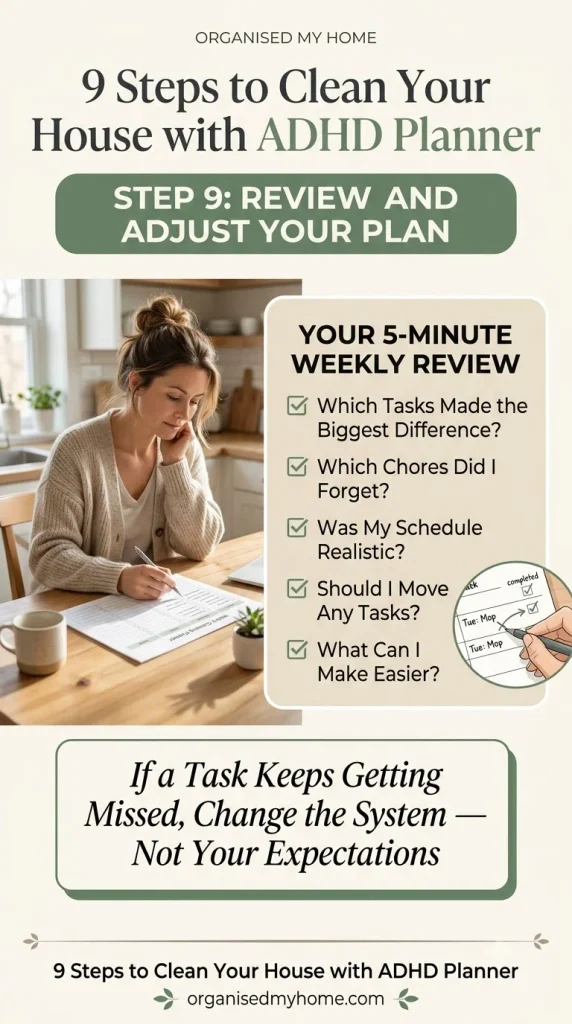
Set aside five minutes to look over your checklist.
Ask yourself:
- Which tasks made the biggest difference?
- Which chores did I repeatedly forget?
- Was my schedule realistic?
- Are any tasks better suited to another day?
- Can I make something easier by changing where I store it?
If you keep missing the same task, don’t automatically blame yourself. Perhaps the reminder isn’t visible, the task is too broad, or the scheduled time doesn’t suit your routine.
Change the system before adding more pressure.
What This Can Look Like in Real Life
Imagine someone who works full-time and shares a home with their family. By Friday evening, there are dishes in the sink, laundry waiting to be folded, toys in the living room, and several chores they meant to complete earlier in the week.
Before: Everything Is in Their Head
They keep remembering tasks at inconvenient times. They write reminders on sticky notes, add some chores to their phone, and tell themselves they’ll clean everything on Saturday.
When Saturday arrives, they don’t know where to begin. They start with the laundry, get distracted by the bedroom, and end up feeling frustrated because several tasks remain unfinished.
After: There’s One Simple Cleaning System
They create a short list of essential chores and place a weekly cleaning planner where they can see it.
On Friday, they check the kitchen and living room priorities. On Saturday, they choose one 15-minute cleaning session and complete the most important tasks first. Anything nonessential moves to another day.
They still have chores to do. Their home isn’t magically spotless.
But they no longer need to remember every task or figure out the entire cleaning plan from scratch. They can see what’s done, what matters next, and what can wait.
That’s the practical value of a simple cleaning system: it helps make the next step clearer.
Benefits of Using an ADHD Cleaning Planner Printable PDF
A printable planner won’t suit everyone, but it can be a useful option if you prefer seeing your tasks on paper.
Here are some potential benefits.
1. It Keeps Household Tasks in One Place
When cleaning responsibilities are spread across messages, notes, and reminders, it can be difficult to see the full picture.
A dedicated planner gives you a consistent place to record recurring chores and household priorities.
2. It Turns Vague Goals Into Clear Actions
Instead of writing “get the house in order,” you can list actions such as clearing the dining table, putting away clean laundry, or wiping the kitchen counters.
Specific instructions make it easier to understand what starting and finishing a task actually mean.
3. It Helps You See Your Progress
A checklist provides a visible record of completed work. Even if you finish only a few tasks, you can recognize what you’ve accomplished rather than focusing exclusively on what remains.
4. It Can Reduce Mental Clutter
Writing down household responsibilities means you don’t have to keep rehearsing every task in your mind.
You may still need phone alarms or calendar reminders for time-sensitive responsibilities, but the planner can serve as a central reference for routine cleaning.
5. It Makes Routines Easier to Repeat
Once you’ve created a manageable weekly schedule, you can reuse it rather than making a new plan from scratch every time.
You can also adjust it as your household changes.
6. It’s Flexible
You can print a fresh page when you need one, write directly on it, move chores between days, or skip sections that aren’t relevant to your home.
You don’t have to follow a printable perfectly for it to be useful.
Why Choose an Organised My Home ADHD Cleaning Planner Printable PDF?
If creating a cleaning system from scratch feels like another task on your already crowded list, a ready-made planner may be worth considering.
The ADHD Cleaning Planner Printable PDF from Organised My Home is intended to provide a practical starting point for organizing everyday cleaning responsibilities.
Rather than requiring you to design your own tracking pages, a printable system can give you a structured place to plan tasks, establish routines, and record progress.
Here are a few reasons you might prefer a ready-made printable.
Budget-Friendly Organization
A printable PDF offers a straightforward alternative to buying a physical planner specifically for household cleaning. You can print the pages you need at home or use a local print service.
Your actual cost will depend on the product price, paper, ink, and printing method you choose. You can also save paper by printing only the pages that are useful to you.
An All-in-One, Ready-to-Use Starting Point
Starting with a blank notebook can require more decisions than you expected. You need to decide what categories to include, how to organize tasks, and how to track progress.
A ready-made planner provides a prepared structure that you can adapt to your household. You can begin with the sections that matter most rather than designing every page yourself.
US Letter and A4 Paper Sizes
Households use different paper sizes depending on where they live and the printer they have.
Organised My Home printable products are designed to offer US Letter and A4 versions, making them suitable for many U.S. and international printing setups. Check the individual product listing for the exact files included.
For the cleanest results, select the matching paper size in your printer settings and preview the page before printing.
Print Only What You Need
Your cleaning needs may change from week to week. You might want a fresh weekly checklist while reusing the same routine reference page.
A printable format gives you the flexibility to print replacement pages when necessary and keep the rest in a folder or binder.
If you want a simple starting point for managing household chores, you can explore the ADHD Cleaning Planner Printable PDF at Organised My Home. Choose the planner that fits your needs and adapt it to your routine.
Free Printables From Organised My Home
You don’t have to purchase a planner to begin organizing your cleaning routine.
Organised My Home also offers selected free printables for readers who want to try simple household organization tools without committing to a paid product.
Explore the website’s available free resources and choose a page that addresses a real problem in your home. You might start by writing down your most frequently forgotten chores, creating a short weekly task list, or identifying the three household jobs that matter most.
You can also use a plain sheet of paper while you decide which format works for you. The important part is finding a system that helps you get started.
Related Home Organization Ideas to Explore
Once your basic cleaning routine feels manageable, you may want to organize other areas of household life.
These related topics can help you build on the same small-step approach:
- Weekly Home Cleaning: Create a repeatable routine for everyday and weekly chores.
- Deep Cleaning Checklist: Break larger cleaning projects into manageable room-by-room tasks.
- Decluttering: Reduce the number of items you need to sort, clean, and put away.
- Home Maintenance: Keep track of important household upkeep tasks without relying entirely on memory.
- Meal Planning: Organize meals and grocery lists to make weekday routines easier to manage.
These are suggested internal-link anchor texts for related Organised My Home articles. Add links when the corresponding articles are available on your website.
Final Thoughts: Your Home Doesn’t Have to Be Perfect
Learning how to clean your house with ADHD isn’t about creating a flawless home or following a rigid schedule every single day.
It’s about making household responsibilities easier to understand, start, and repeat. One cleared counter, one load of laundry, or one short cleaning session can be a meaningful step forward.
Start with your essentials. Break large chores into smaller actions. Keep your plan somewhere visible, and give yourself permission to adjust it when life gets busy.
If a ready-made structure would help, the ADHD Cleaning Planner Printable PDF from Organised My Home can give you a place to organize your tasks and track your progress. You can also explore the site’s selected free printables to find a simple tool that suits your needs.
I’m Prince Mali, and at Organised My Home, the goal is to make everyday home management more practical and less overwhelming.
You don’t need a perfect routine to make progress. You just need a next step you can manage.






[…] Explore More: How to Clean Your House with ADHD: Steps with an ADHD Cleaning Planner […]
[…] Explore More: How to Clean Your House with ADHD: Steps with an ADHD Cleaning Planner […]