There’s a particular kind of home stress that happens when you suddenly realize you were supposed to do something months ago.
Maybe the HVAC filter hasn’t been checked. There’s a small drip under the sink you keep meaning to investigate. The gutters need attention, a light fixture is acting strangely, and you vaguely remember that the smoke alarms should be tested regularly. None of these jobs feels huge by itself, but when they pile up, home maintenance can start feeling like a second job.
The frustrating part is that most homeowners aren’t necessarily ignoring their homes. Life simply gets busy, and maintenance tasks are easy to forget when they’re scattered across calendars, phone reminders, receipts, notes, and your memory.
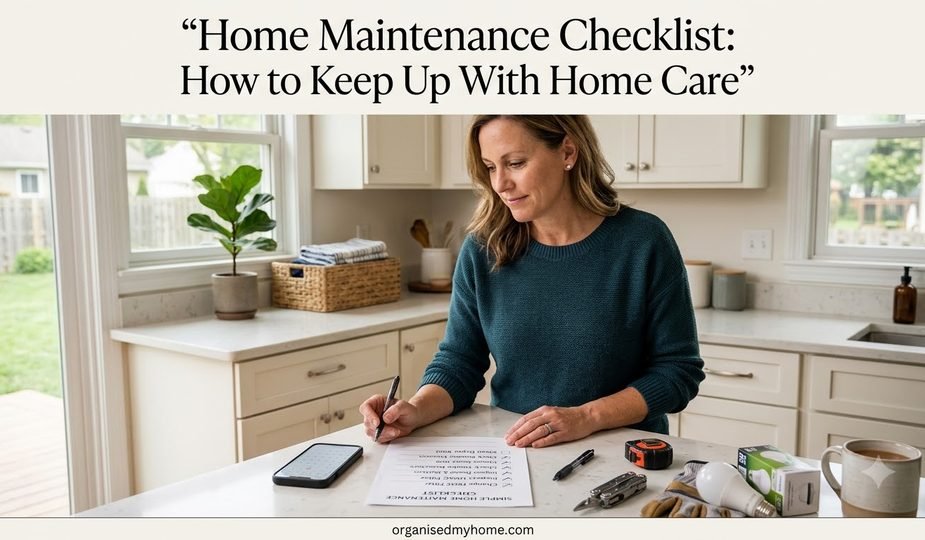
A simple Home Maintenance Checklist can give those tasks a place to live.
At Organised My Home, blogger Prince Mali shares practical ideas and simple systems designed to make everyday home responsibilities easier to manage. The goal isn’t to create a perfectly maintained house. It’s to make the next task easier to see and easier to handle.
And there’s good reason to take routine maintenance seriously. The U.S. Department of Housing and Urban Development recommends regular checks for things such as water leaks, roof damage, locks, vents, filters, cracks, gutters, and other areas of the home.
So, how do you actually keep up with everything?
The Problem: Home Maintenance Is Easy to Forget
Home maintenance is different from cleaning because many maintenance tasks don’t need attention every day.
You might clean the kitchen several times a week, but you aren’t necessarily thinking about the roof, water heater, gutters, smoke alarms, caulking, HVAC system, or exterior of your home while you’re making dinner.
That creates a memory problem.
You may think:
- “I’ll check that this weekend.”
- “I need to remember to replace that.”
- “I should probably call someone about that.”
- “Was that last year or two years ago?”
- “I know I wrote that down somewhere.”
Eventually, the small jobs become a long mental list.
Why Maintenance Gets Overwhelming
Another problem is that home maintenance doesn’t come as one neat list.
Some tasks are monthly. Others may be seasonal or annual. Some depend on your home’s age, location, appliances, systems, manufacturer’s instructions, or the recommendations of a qualified professional.
That means trying to create the entire system from memory can be surprisingly difficult.
The answer isn’t necessarily more motivation.
You may simply need a simpler system.
Instead of remembering everything, you can record what needs to be checked, when you checked it, what needs attention, and what the next step should be.
That small change can make home maintenance feel much more manageable.
What a Home Maintenance Checklist Can Help You Track
A useful checklist isn’t just a list of chores. It can become a central place for keeping track of responsibilities around the house.
For example, your system might include:
Safety Checks
Safety-related items deserve particular attention.
The U.S. Fire Administration recommends testing smoke alarms monthly and replacing smoke alarms when they reach 10 years old. It also recommends having smoke alarms inside bedrooms, outside separate sleeping areas, and on every level of the home.
Your checklist can give you a place to record when these checks were completed.
Plumbing and Water
Look for visible leaks around sinks, toilets, appliances, pipes, and other accessible areas.
A small water problem shouldn’t automatically be treated as something you can fix yourself. If you find a significant leak, hidden moisture, electrical involvement, or a problem you’re not qualified to handle, contact an appropriate professional.
HVAC and Airflow
Keep track of routine filter checks or replacements according to the equipment manufacturer’s recommendations.
You can also record professional service appointments, unusual noises, or issues you want to ask about later.
Exterior and Roof Areas
Depending on your home and location, your maintenance list may include gutters, roof condition, exterior cracks, doors, windows, drainage, trees, walkways, and other visible areas.
HUD’s healthy-home maintenance guidance includes checking roofs for leaks or damage, clearing debris around the home, inspecting walls for cracks and holes, and checking for water leaks.
You don’t need to climb onto a roof or attempt a dangerous inspection yourself. A checklist should help you remember what needs attention—not encourage unsafe DIY work.
Appliances and Household Equipment
Record routine maintenance for appliances and equipment based on their manuals.
This is especially useful when you have several appliances because it becomes much easier to remember what was checked and what still needs attention.
How to Keep Up With Home Maintenance Step by Step
The easiest way to build a maintenance routine is to stop treating the entire house as one giant project.
Break it down.
Step 1: Start With What Your Home Actually Needs
Don’t begin by copying a giant generic checklist and assuming every item applies to your house.
Start with your actual home.
Think about:
- How old is the house?
- What heating and cooling system do you have?
- Do you have a basement, attic, garage, or crawl space?
- What appliances need regular maintenance?
- What outdoor areas need attention?
- Are there tasks recommended by manufacturers?
- Are there recurring repairs you’ve already noticed?
Your maintenance list should fit your home.
Step 2: Gather the Information You Already Have
Look for information that’s already available before creating new reminders.
Check:
- Appliance manuals
- HVAC service records
- Previous repair receipts
- Warranty information
- Contractor paperwork
- Home inspection documents
- Previous maintenance notes
- Manufacturer maintenance instructions
You don’t have to organize every document perfectly on the first day.
The goal is simply to gather useful information in one place.
Step 3: Walk Through Your Home
Do a slow, practical walkthrough.
Start outside and move through the house.
Look for obvious things that need attention, such as:
- Drips or signs of water
- Damaged caulking
- Cracks
- Loose hardware
- Sticking doors or windows
- Damaged screens
- Blocked vents
- Unusual appliance sounds
- Worn hoses or visible connections
- Exterior debris
- Lighting that isn’t working
- Safety devices that need checking
Write down what you actually notice.
Don’t turn the walkthrough into a three-hour project. You’re creating a list, not completing every repair.
Step 4: Break Big Jobs Into Smaller Actions
“Maintain the house” isn’t an actionable task.
“Check under kitchen sink for leaks” is.
“Take care of HVAC” is vague.
“Check filter according to manufacturer recommendations” is much clearer.
Whenever possible, turn a large responsibility into a specific next action.
This reduces the amount of thinking required when it’s time to actually do the work.
Step 5: Give Each Task a Place on Your Schedule
Now decide how often each task needs attention.
Some items may be monthly. Others may be handled less frequently. Certain tasks may be seasonal or based on manufacturer recommendations.
Don’t automatically assign the same frequency to every item.
For equipment and appliances, follow the manufacturer’s instructions. For safety systems, follow guidance from appropriate authorities and the equipment manufacturer.
The goal is to create a realistic schedule—not a calendar so crowded that you’ll abandon it after two weeks.
Step 6: Use a Home Maintenance Checklist
This is where a printable system can become useful.
The Home Maintenance Checklist Printable PDF from Organised My Home is designed to give you a simple place to organize maintenance responsibilities instead of keeping everything in your head.
You can use it to see what needs attention, record progress, make notes, and keep recurring responsibilities more visible.
The printable doesn’t maintain your home for you. You still have to make the call, replace the filter, inspect the area, schedule the service, or complete the repair.
What it can do is remove some of the organizational work surrounding those tasks.
Step 7: Record What You Completed
Don’t rely on memory after you’ve finished something.
Mark it down.
A simple record can answer questions like:
- When was this last checked?
- Was anything unusual noticed?
- Does something need repair?
- Did I contact a professional?
- When should I check it again?
- Do I need a replacement part?
This becomes especially helpful when several months pass between maintenance tasks.
Step 8: Separate “Do It” From “Get Help”
Not every maintenance task should become a DIY project.
If you’re uncomfortable with electrical work, roofing, gas systems, structural concerns, major plumbing problems, or another potentially dangerous repair, get appropriate professional help.
Your checklist can still be useful.
Instead of writing “fix electrical issue,” write something like:
“Contact qualified electrician about outlet.”
Now the task has a clear next action without requiring you to do work you’re not qualified to perform.
Step 9: Review Your List Regularly
Set aside a small amount of time to review the checklist.
You might do this once a month or choose another interval that fits your household.
Ask:
- What did I complete?
- What still needs attention?
- Did I discover anything new?
- Are any tasks no longer relevant?
- What needs to happen next?
This keeps the checklist from becoming another forgotten piece of paper.
What This Can Look Like in Real Life
Imagine a homeowner named Sarah.
Before creating a maintenance system, Sarah keeps everything in different places.
She has a reminder on her phone about an HVAC appointment, a handwritten note about a leaking faucet, an email about an appliance warranty, and a piece of paper reminding her to check the gutters.
She remembers some things.
She forgets others.
When something comes up, she spends time trying to remember whether it was already handled.
After creating a simple maintenance system, Sarah puts her recurring home responsibilities into one visible place.
Now she can see:
Needs attention:
Kitchen sink leak
Scheduled:
HVAC service
Check:
Smoke alarms
Outdoor:
Inspect gutters
Notes:
Ask professional about window issue
The house hasn’t magically become maintenance-free.
But Sarah doesn’t have to keep the entire list in her head anymore.
That’s the real benefit of a simple system: the next action becomes easier to see.
Why Printable PDFs Can Make Home Maintenance Easier
A printable PDF won’t replace good judgment, professional advice, or actual maintenance.
But it can provide a simple visual structure for the work.
They Put Information in One Place
Instead of scattered notes and reminders, a printable can give you one physical reference point.
They Make Tasks Easier to See
A visible checklist can make forgotten responsibilities more noticeable than a task buried inside a phone notification.
They Can Help Build Consistency
Repeating a simple process can make maintenance feel more routine rather than something you only think about when a problem appears.
They May Reduce Mental Clutter
When you don’t have to remember every task yourself, there’s less information competing for space in your mind.
They’re Flexible
You can write notes, check completed tasks, add dates, and adapt the system to your household.
You Can Print What You Need
You don’t necessarily need a complicated binder with dozens of pages.
You can print the pages that are useful to you and keep the rest for later.
Why Choose an Organised My Home Printable?
If you prefer a ready-made system instead of designing your own checklist from scratch, an Organised My Home printable can provide a practical starting point.
The Home Maintenance Checklist Printable PDF is designed around everyday usability rather than making home organization unnecessarily complicated.
Budget-Friendly
Printable products can be a simple, budget-friendly way to introduce an organization system without buying a physical planner or specialized home-management book.
You can print the pages you need and reuse the structure as part of your household routine.
All-in-One and Ready to Use
Instead of spending time designing categories, headings, checkboxes, and tracking areas yourself, a ready-made printable gives you an organized framework to start with.
That means you can spend more time managing your home and less time creating the paperwork for managing it.
US Letter and A4 Sizes
Organised My Home printables are designed to accommodate both US Letter and A4 paper sizes.
For U.S. readers, US Letter is the familiar 8.5 × 11-inch paper size used by most home printers. A4 is also available for people who use that format.
Print at Home or Through a Print Service
You can print the pages at home if you have a printer, or use a local or online print service if you prefer professional printing.
And because it’s a digital product, you can print the pages you need rather than having to buy a physical planner that may contain sections you never use.
Free Printables From Organised My Home
Not every organization problem needs a paid product.
Organised My Home also provides selected free printables so readers can try simple organization tools without committing to a purchase.
It’s a useful way to experiment with printable planning and discover which types of systems actually fit your household.
If a simple checklist helps you stay on top of one area of your home, you may find that the same approach works for other responsibilities too.
Helpful Home Organization Resources to Explore Next
Once you have a maintenance system in place, you can build a broader home-management routine around it.
Consider exploring these related topics on Organised My Home:
- Weekly Home Cleaning — for keeping everyday cleaning tasks manageable
- Deep Cleaning Checklist — for larger cleaning projects
- Home Organization — for creating more functional spaces
- Home Budget Planner — for organizing household spending
- Meal Planning — for simplifying weekly food decisions
These systems don’t have to be created all at once. Start with the area that’s currently causing the most frustration and build from there.
A Simple Home Maintenance Routine Is Better Than a Perfect One
You don’t need to remember every home maintenance task perfectly.
You don’t need a huge binder.
You don’t need to spend an entire weekend creating a complicated household management system.
Start small.
Walk through your home. Write down what actually needs attention. Break larger responsibilities into smaller actions. Record what you’ve completed. Schedule the things that need professional help. Then review the list regularly.
A Home Maintenance Checklist can simply give all of those little responsibilities a visible place to live.
That’s what Organised My Home is about. Prince Mali shares practical ideas and straightforward systems that can help make everyday home responsibilities feel less scattered and more manageable.
If you’d like a ready-made place to organize your maintenance tasks, you can explore the Home Maintenance Checklist Printable PDF and see whether it fits the way you manage your home. And if you’re just getting started, take a look at the free printables from Organised My Home too.
An organized home doesn’t have to be perfect.
Sometimes, it just needs a simple system that helps you remember what matters and makes the next