You start Monday with good intentions. This week, you’ll keep the kitchen clean, stay on top of laundry, and make sure the bathroom doesn’t get out of hand. You might even write a detailed cleaning schedule and feel relieved that everything finally has a plan.
Then Wednesday arrives. Work runs late, a load of laundry stays in the dryer, dishes pile up, and your carefully planned routine starts falling apart. By the weekend, you’re frustrated and wondering why it’s so difficult to stick with something that seems straightforward for everyone else.
If you have ADHD, this experience may sound familiar. Keeping a home clean involves remembering tasks, getting started, switching between activities, estimating time, and following through—even when the chores aren’t particularly interesting.
The answer isn’t necessarily a stricter schedule. It may be a simpler routine designed around your real life.
I’m Prince Mali, the blogger behind Organised My Home. I share practical ideas and simple systems that help people manage everyday household responsibilities more easily. My approach to home organization is straightforward: create routines that support your life instead of adding another source of pressure.
In this article, you’ll learn how to build an ADHD-friendly cleaning routine you can realistically maintain, how to recover when you miss a day, and how an ADHD Cleaning Planner Printable PDF can help you keep your household tasks visible and manageable.
Why Is It So Hard to Follow a Cleaning Routine with ADHD?
Cleaning isn’t just about physical effort. It also involves planning, remembering what needs attention, deciding what to do first, and returning to a task after an interruption.
ADHD can affect executive functioning, including organization, working memory, attention, and task initiation. These difficulties may make everyday household responsibilities harder to manage. The Centers for Disease Control and Prevention (CDC) provides an overview of how ADHD can affect adults’ daily lives.
Here are some common reasons cleaning routines fall apart.
- The routine is too ambitious. A schedule with ten chores every day may look organized on paper but leave little room for unexpected responsibilities.
- You depend on remembering everything. Without a visible reminder, it’s easy to forget a task until it becomes urgent.
- Every chore requires another decision. You spend time deciding whether to clean the kitchen, fold laundry, or tidy the bedroom instead of beginning.
- You get distracted halfway through. One task leads to another, and the original job remains unfinished.
- You lose track of time. A quick cleanup can take longer than expected, pushing the rest of your schedule aside.
- Missing one day feels like failure. You assume the routine is ruined and postpone starting again until Monday.
There’s also the problem of creating a routine for an ideal version of your life. Perhaps you planned to clean for 45 minutes every evening, but by the time dinner and other responsibilities are finished, you have very little energy left.
A routine should work on ordinary days, not just your most productive ones.
You don’t need to clean every room daily. You need to identify the tasks that matter most, make them easier to begin, and create a way to return to your routine when life interrupts it.
How an ADHD Cleaning Planner Can Make Your Routine Easier
An ADHD Cleaning Planner Printable PDF gives you a visual place to organize your cleaning responsibilities instead of keeping every task in your head.
You can use a planner to separate daily essentials from weekly chores, break larger jobs into smaller actions, and decide what deserves your attention first.
For example, instead of writing “clean the kitchen,” your checklist might say:
- Put dirty dishes in the dishwasher.
- Clear the main countertop.
- Wipe the food preparation surface.
- Sweep visible crumbs from the floor.
The next action is clear, and you don’t have to plan the entire job again every time you look at the list.
A planner can also help you:
- Track what you’ve completed.
- Keep unfinished tasks visible without worrying about forgetting them.
- Choose chores that fit the time you have available.
- Repeat useful routines without starting from scratch.
- Notice which parts of your schedule aren’t working.
- Adjust your plan without treating missed tasks as personal failures.
A printable doesn’t remove ADHD-related challenges or do the cleaning for you. It provides a simple visual structure that may reduce decision-making and make the next step easier to identify.
The best routine isn’t the most detailed one. It’s the one you can return to, even after a difficult day.
Explore More: How to Clean Your House with ADHD: Steps with an ADHD Cleaning Planner
How to Build an ADHD Cleaning Routine You Can Actually Follow
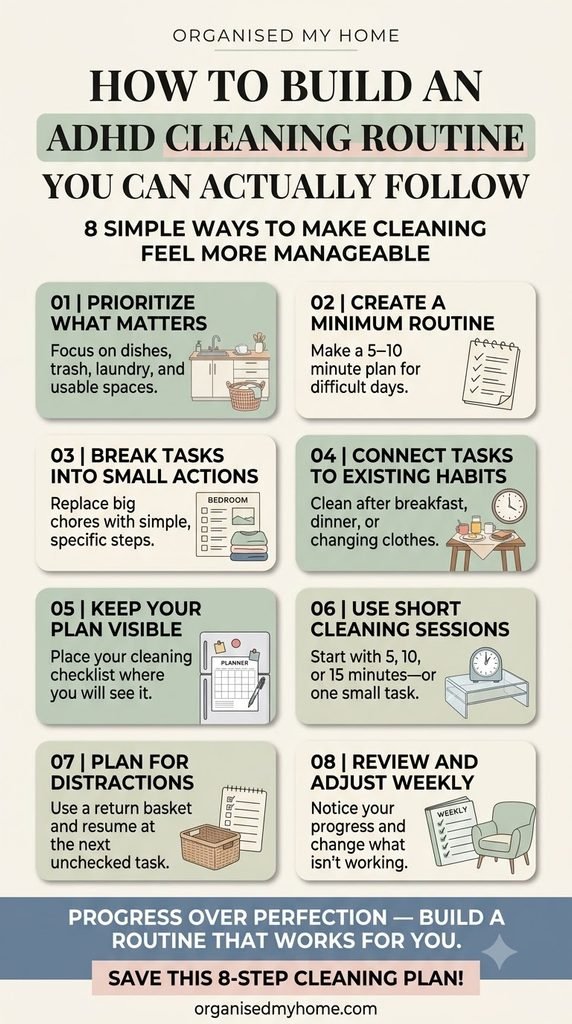
The following steps will help you create a practical cleaning routine without trying to change your entire household at once.
Step 1: Identify the Cleaning Tasks That Matter Most
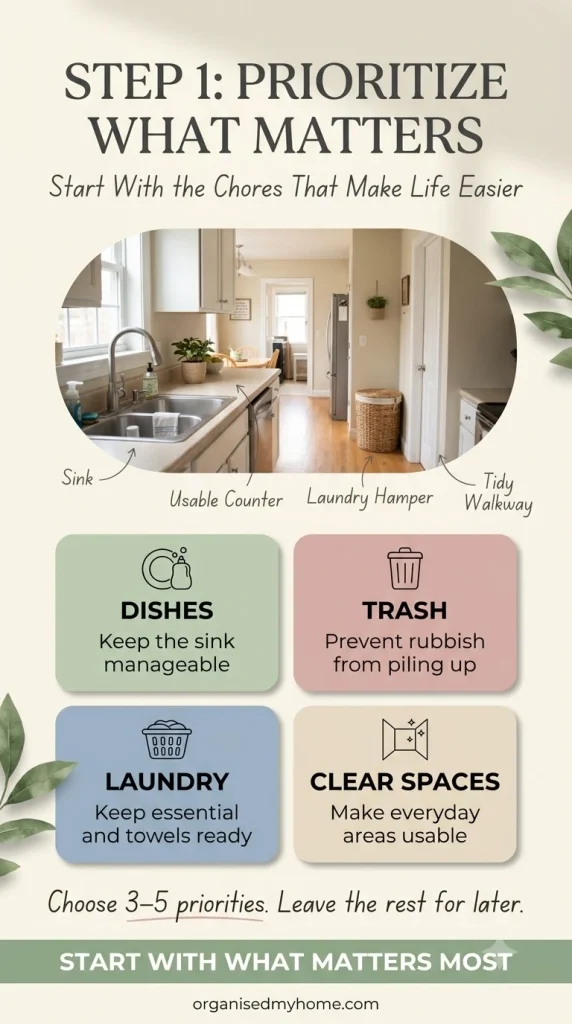
Before creating a schedule, decide what your household genuinely needs.
Walk through your home and notice which unfinished chores affect everyday life the most. Perhaps dishes are regularly left overnight, laundry collects on the bedroom floor, or the bathroom becomes difficult to maintain.
Start with the tasks that affect hygiene, comfort, and daily functioning.
For many households, these include:
- Managing dirty dishes and food preparation surfaces.
- Keeping trash under control.
- Washing essential clothing and towels.
- Maintaining a usable bathroom.
- Clearing frequently used surfaces and walkways.
You don’t have to include every household chore in your first routine.
If vacuuming every room daily isn’t necessary for your household, don’t put it on your daily list. If you have pets or young children, your priorities may be different from those of someone living alone.
Your first goal is to identify the few tasks that make the biggest difference to your day.
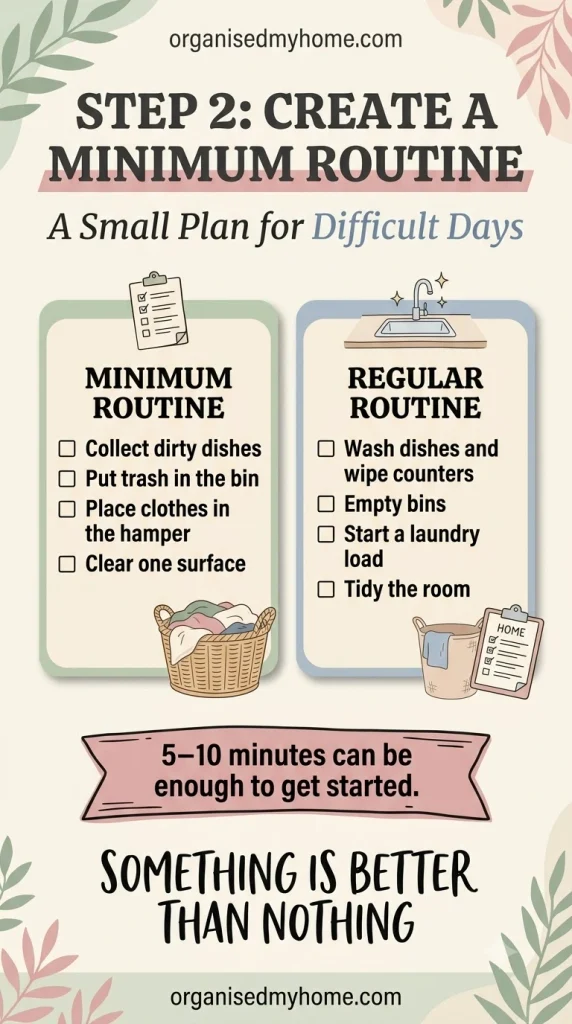
Step 2: Create a Minimum Routine for Difficult Days
One of the most useful changes you can make is to stop treating every day as though you’ll have the same amount of time and energy.
Create two versions of your routine: a minimum version and a regular version.
Your minimum routine might take five to ten minutes and focus on essential tasks. Your regular routine can include additional chores when time allows.
For example:
| Minimum routine | Regular routine |
|---|---|
| Collect dirty dishes | Wash dishes and wipe counters |
| Put trash in the bin | Empty bins and replace liners |
| Place dirty clothes in the hamper | Start or finish a laundry load |
| Clear one frequently used surface | Tidy the rest of the room |
These are examples, not rules. Choose tasks that suit your household and schedule.
On a difficult day, completing your minimum routine can help keep basic responsibilities from accumulating. On a more manageable day, you can do the additional tasks.
This approach also gives you a way to continue after a disrupted day. You don’t have to choose between completing everything and doing nothing.
Step 3: Break Each Chore Into Clear, Small Actions
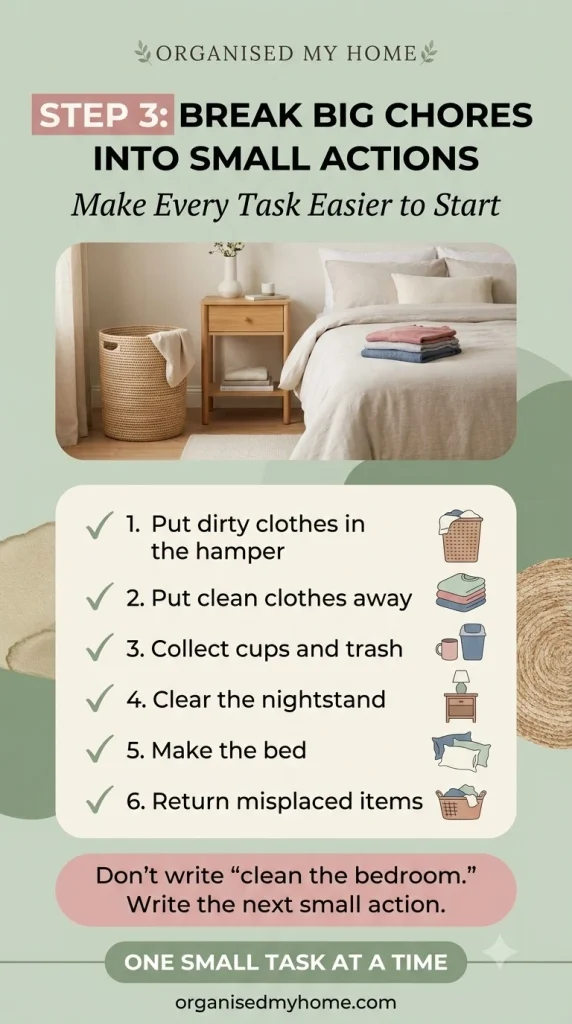
Vague instructions create more decisions.
When you write “organize bedroom” on your schedule, you still have to figure out what that means. Should you fold clothes, change the sheets, clear the dresser, or organize the closet?
Instead, break the job into specific actions.
For example, a bedroom reset could include:
- Put dirty clothes in the hamper.
- Return clean clothes to their storage space.
- Remove cups and trash.
- Clear the nightstand.
- Make the bed.
- Put misplaced items in their designated places.
You can complete these actions in one session or divide them across several short sessions.
Apply the same idea to laundry. Rather than treating laundry as one endless chore, separate it into washing, drying, folding, and putting away.
If you regularly stop after folding clothes, make “put away one basket” a separate task with its own place on the checklist.
The smaller the action, the easier it may be to see where to start and when you’ve finished.
Step 4: Attach Cleaning Tasks to Routines You Already Have
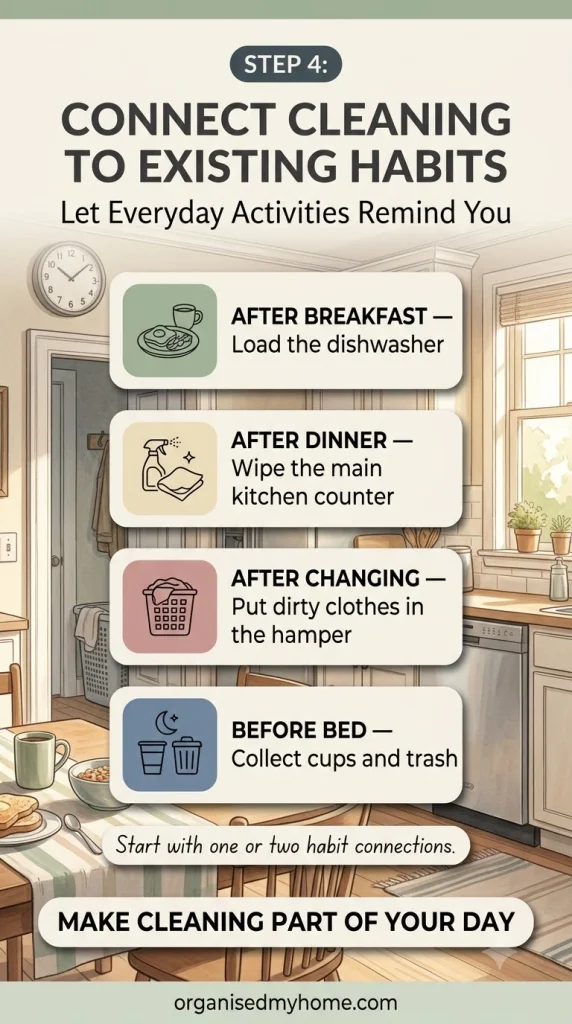
Instead of scheduling every chore at an exact time, connect a few tasks to things you already do.
For example:
- After breakfast, load the dishwasher.
- Before going to bed, collect cups and trash from the living room.
- After taking off your clothes, put dirty items directly in the hamper.
- After finishing dinner, wipe the main kitchen counter.
- On a day when you already have time for laundry, fold one load afterward.
These connections can make cleaning feel like part of an existing activity rather than another separate event you must remember.
You can also choose a regular time window instead of a strict clock time. Perhaps you do a short reset sometime after dinner rather than insisting that it must happen at exactly 7:00 p.m.
Experiment with one or two routine connections first. If they become useful, add another.
Step 5: Keep Your Cleaning Plan Visible
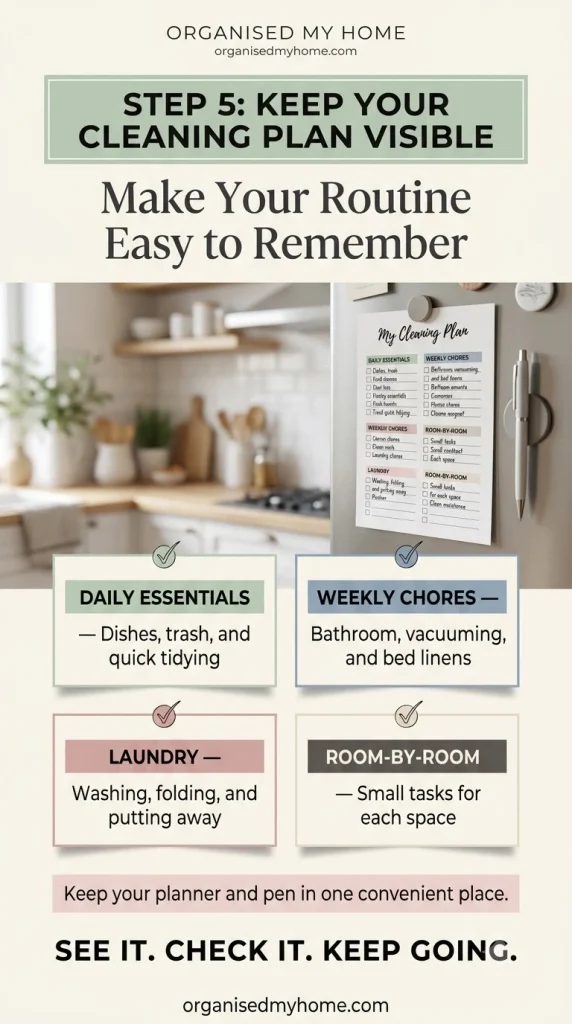
A routine is difficult to follow if you forget that it exists.
Choose a place where you’ll naturally see your cleaning checklist. You might keep it on the refrigerator, inside a kitchen cupboard, on a clipboard, or near your cleaning supplies.
A paper planner can be especially useful if you prefer seeing the entire list at once rather than opening an app.
Use simple categories, such as:
- Daily essentials
- Weekly chores
- Laundry
- Room-by-room cleaning
- Tasks to do when time allows
Don’t fill every section immediately. Start with the tasks you’ve already identified as important.
If you use an ADHD Cleaning Planner, keep a pen nearby so you can check off completed jobs without searching for supplies.
Make the system easy to use when you’re tired. A short checklist in a visible place is often more practical than a complicated system you need to maintain.
Step 6: Use Short Cleaning Sessions to Get Started
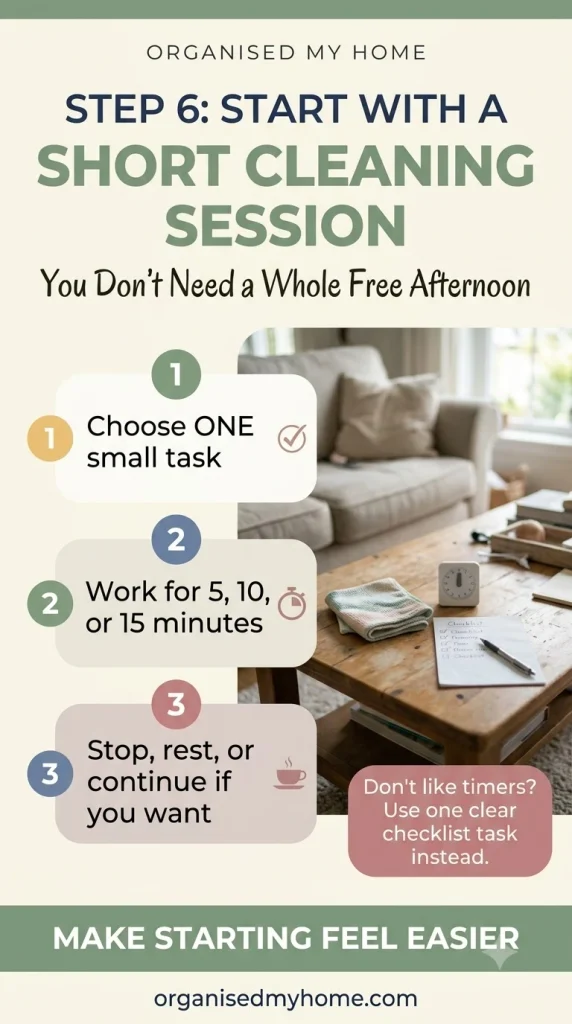
You don’t have to wait until you have an entire free afternoon.
Choose one task and work on it for five, ten, or fifteen minutes. The length should feel manageable rather than intimidating.
For example, set a ten-minute timer and focus only on clearing the dining table. When the timer ends, you can stop, take a break, or continue if you feel able.
If timers make you anxious or distract you, use a checklist with a clear stopping point instead.
Try to avoid turning a short cleaning session into an unplanned whole-house project. If you notice the closet needs organizing while clearing the bedroom, write that down for later rather than switching tasks immediately.
The aim is to create a manageable starting point and make progress without requiring a burst of motivation.
Step 7: Plan for Distractions and Interrupted Tasks
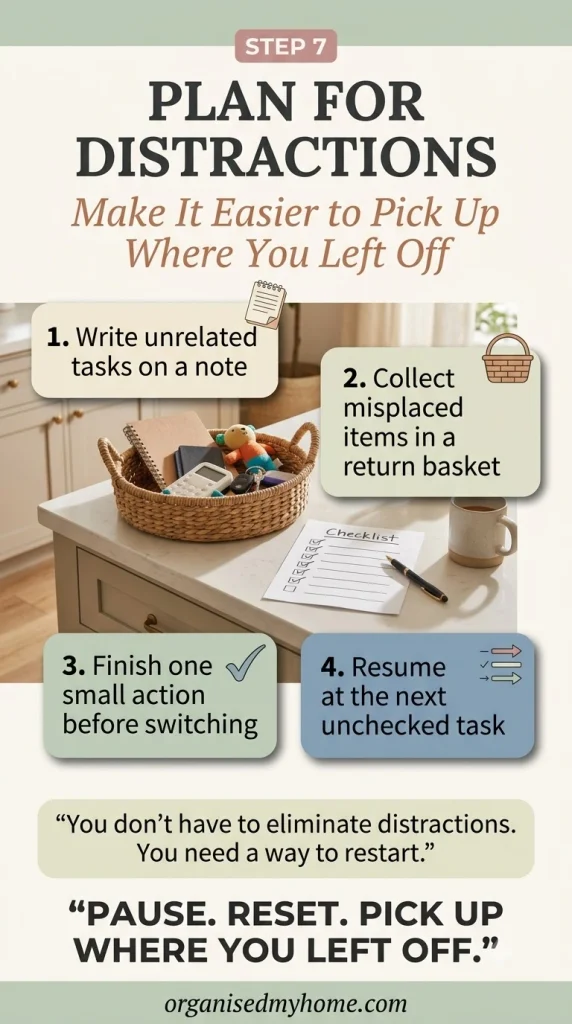
Even a simple routine can be interrupted by phone calls, family needs, unexpected errands, or other distractions.
Instead of assuming every cleaning session will go smoothly, build a way to return to unfinished work.
You can try these strategies:
- Keep a small note nearby for unrelated tasks that come to mind.
- Use a basket for belongings that need to go to other rooms.
- Finish one small action before moving to another chore.
- Write down where you stopped if you need to leave a task.
- Return to the next unchecked step rather than starting the whole job again.
For instance, if you are cleaning the kitchen and remember that the bedroom laundry needs attention, write “start laundry” on your list. Finish the kitchen task before deciding whether you have time to switch.
You don’t need to eliminate distractions completely. You need a practical way to resume your routine after they happen.
Step 8: Review Your Routine Once a Week
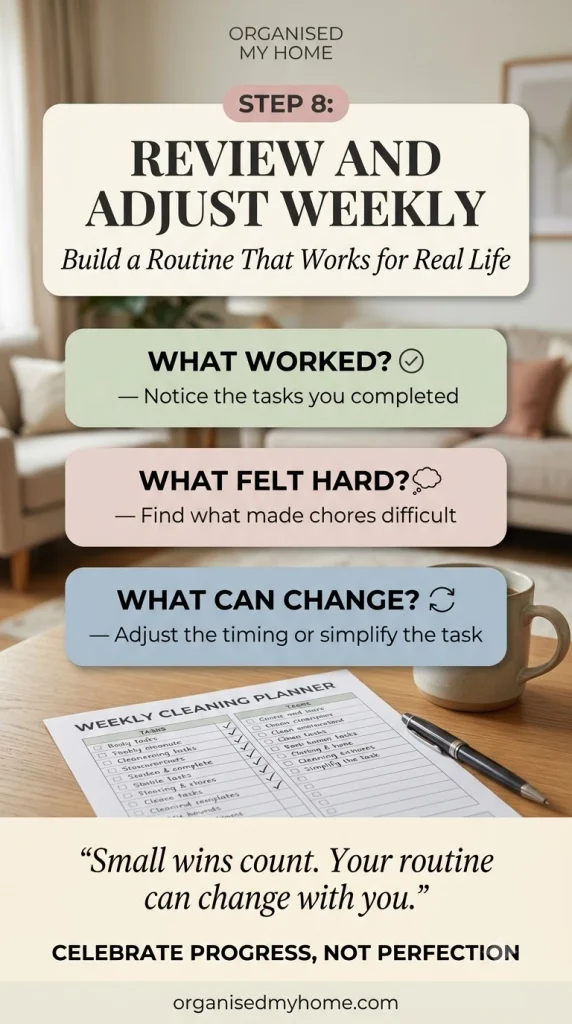
A cleaning routine should be adjustable. If you repeatedly skip a particular task, don’t automatically assume you need more discipline.
Ask yourself what is making the task difficult.
Perhaps the chore takes longer than expected, the supplies are inconvenient to reach, or the task is scheduled at a time when you’re usually tired.
Try changing one thing at a time.
For example, if folding laundry regularly gets postponed until the weekend, try folding one small load on a different day. If your evening cleaning session rarely happens, move it to a time when you have more energy.
Use your planner to note which tasks you completed, which ones you skipped, and what you want to change next week.
You can also celebrate small wins. Finishing a short task, clearing a frequently used surface, or returning to your routine after a difficult week is progress worth recognizing.
CHADD’s advice on organizing the home and office recommends approaches such as breaking projects into smaller steps, using timers, and making use of support when needed.
Remember, your routine doesn’t have to stay the same forever. It should change as your household, schedule, and needs change.
What This Can Look Like in Real Life
Imagine someone who works full-time and has struggled to keep up with dishes, laundry, and general tidying. Every Sunday, they create a detailed cleaning schedule. By Tuesday, they’re already behind, and by Friday, the unfinished checklist feels discouraging.
Before: Cleaning depends on memory and motivation. Tasks are scattered across phone reminders, sticky notes, and mental lists. When one chore is missed, the entire schedule feels ruined.
After: They use a visible cleaning planner with three daily priorities and a short list of weekly chores. Their minimum routine includes collecting dishes, putting dirty clothes in the hamper, and clearing one frequently used surface. On days with more time, they add another task.
They also choose a regular weekly time to review the planner. Unfinished chores are moved to realistic dates rather than treated as evidence of failure.
The home doesn’t stay perfectly clean every day. However, there is a clear place to check what needs attention, and returning to the routine is less complicated.
That’s what makes a simple system useful: it doesn’t depend on every day going according to plan.
Benefits of Using Printable PDFs for ADHD Cleaning
A printable cleaning planner isn’t the only way to manage chores. Digital calendars, reminder apps, whiteboards, and handwritten lists can all work well for different people.
A paper checklist may be worth trying if you prefer a visual reminder that stays in one place.
Here are some potential benefits.
- Tasks stay together. You can keep cleaning priorities on one dedicated page instead of searching through different notes.
- The next step is visible. A checklist makes it easier to identify what needs attention without planning everything again.
- Progress is easy to track. Checking off completed chores provides a visible record of your work.
- Routines become repeatable. You can reuse the same cleaning structure rather than making a new plan each day.
- It can reduce mental clutter. Writing down responsibilities gives you a place to refer back to when you’re worried about forgetting something.
- It’s flexible. You can change tasks, add notes, and adjust your schedule to suit your household.
- You can print pages when needed. Keep the pages you use regularly and print fresh copies when you want to start again.
A printable won’t guarantee consistency or eliminate distractions. Its value is in providing a straightforward structure that you can adapt to your needs.
Why Choose an Organised My Home ADHD Cleaning Planner?
If you want a ready-made starting point, the ADHD Cleaning Planner Printable PDF from Organised My Home is designed to fit naturally into a practical home organization system.
Rather than starting with a completely blank page, you can use a prepared planner as a framework for organizing cleaning responsibilities and deciding what to tackle next.
The aim is to make everyday tasks easier to plan and track without creating another complicated system to maintain.
Budget-Friendly and Practical
A printable PDF provides a digital file you can print when needed. Instead of purchasing a new physical planner every time you want to change your routine, you can work with the pages available in your purchased file.
Remember that printing costs, paper, and ink may affect the total expense. Choose the printing method that fits your budget.
An All-in-One, Ready-to-Use Starting Point
Creating your own cleaning system requires decisions about categories, task lists, and progress tracking.
A ready-made printable gives you a starting structure. You can choose the relevant pages, personalize your routine, and leave out tasks that don’t apply to your home.
The objective isn’t to fill in every box. It’s to use the parts that help you manage your responsibilities.
US Letter and A4 Paper Sizes
Organised My Home printable products are designed with US Letter and A4 paper options. US Letter is convenient for many American households, while A4 accommodates readers using that paper size.
Check the individual product listing to confirm which files are included.
You can print the pages at home or use a local print service. Keep your planner somewhere visible and print only the pages you need for your routine.
Free Printables From Organised My Home
You don’t have to buy a planner to start making your cleaning routine more manageable.
Organised My Home also offers selected free printables, giving readers an opportunity to try simple organization tools without purchasing a product.
Explore the available free resources and choose one that suits your current needs. You can begin with a single checklist or another relevant printable and see whether a visual system fits your daily routine.
There’s no need to create a complicated home management system before you’ve discovered what works for you.
Suggested Internal Links
These are suggested anchor texts for related articles you can link to when the corresponding pages are available on Organised My Home. No URLs have been assumed.
- Weekly Home Cleaning Checklist — for maintaining your routine after you’ve established it.
- Deep Cleaning Checklist — for planning less frequent, more detailed chores.
- Simple Home Organization Ideas — for making everyday belongings easier to put away.
- Decluttering Your Home One Room at a Time — for managing clutter without trying to tackle every room at once.
- Room-by-Room Cleaning Checklist — for turning large cleaning jobs into smaller tasks.
Start Building a Routine That Fits Your Life
If you’d like a ready-made structure, explore the ADHD Cleaning Planner Printable PDF from Organised My Home. It can give you a practical place to organize tasks, track progress, and adjust your routine as your needs change.
You can also explore the available free printables if you’d prefer to begin with a no-cost option.
Most importantly, start with a routine small enough to use on an ordinary day. Choose a few essential chores, keep your list visible, and give yourself permission to restart whenever you need to.
Final Thoughts
Building a cleaning routine with ADHD isn’t about becoming a perfectly organized person. It’s about finding a manageable way to handle household responsibilities without depending on motivation alone.
Start by identifying your priorities, creating a minimum routine, breaking chores into small actions, and keeping your plan somewhere visible. Review it regularly, and change what isn’t working.
Some weeks will go smoothly. Others won’t. A useful routine gives you a way to continue after interruptions rather than making you feel that you’ve failed.
At Organised My Home, Prince Mali shares practical ideas and printable resources to help make everyday home responsibilities easier to manage. Whether you choose the ADHD Cleaning Planner Printable PDF or start with a free printable, remember that your system should work for you—not the other way around.
You don’t need a perfect routine. You need one simple enough to come back to tomorrow.