Have you ever cleaned one room, felt proud of yourself, and then noticed that the kitchen counter, closet, entryway, or dining table is already covered with stuff again?
Maybe you have a drawer full of things you rarely use, clothes you keep “just in case,” papers you might need someday, or random household items that don’t seem to have a proper home. The frustrating part isn’t always the amount of stuff. Sometimes it’s simply not knowing where to start.
Research has found that clutter and unfinished household tasks can be associated with a home feeling more stressful rather than restorative. A UCLA study of families also found connections between how people described their homes and patterns of stress.
That doesn’t mean a messy home is automatically unhealthy or that you need a perfectly organized house. It simply shows why clearing some visual and physical clutter can feel surprisingly relieving.
I’m Prince Mali, the blogger behind Organised My Home, where I share practical ideas and simple systems to make everyday home responsibilities easier to manage. One thing I’ve learned from creating home-organization resources is that you usually don’t need more pressure to get organized. You often need a simpler system and a clear next step.
If your home feels crowded or difficult to keep under control, these five steps can help you declutter without trying to transform the entire house in one exhausting weekend.
Why Is It So Hard to Declutter Your Home?
Decluttering sounds simple: get rid of things you don’t need.
Actually doing it is different.
Every item can come with a decision:
- Do I still use this?
- What if I need it later?
- Should I donate it?
- Can I sell it?
- Does someone else in the family want it?
- Does this have sentimental value?
- Where should it go?
- What should I do with it after I decide?
That’s a lot of decisions.
And when you have a full-time job, children, errands, meals, laundry, bills, cleaning, and other household responsibilities, decluttering can easily become another unfinished task sitting on your mental to-do list.
There’s also an emotional side. Researchers studying clutter have found that possessions can be difficult to let go of because they may be connected to memories, emotions, or the feeling that an item could be useful someday.
So don’t start by telling yourself, “I need to get rid of everything.”
Start by making the process easier.
A Simple Declutter Strategy That Actually Feels Manageable
The goal isn’t to create an Instagram-perfect home.
The goal is to make your home easier to live in.
Instead of walking through every room and asking yourself what needs to change, use a simple process:
Choose → Sort → Decide → Organize → Maintain
That’s the basic idea behind the five steps below.
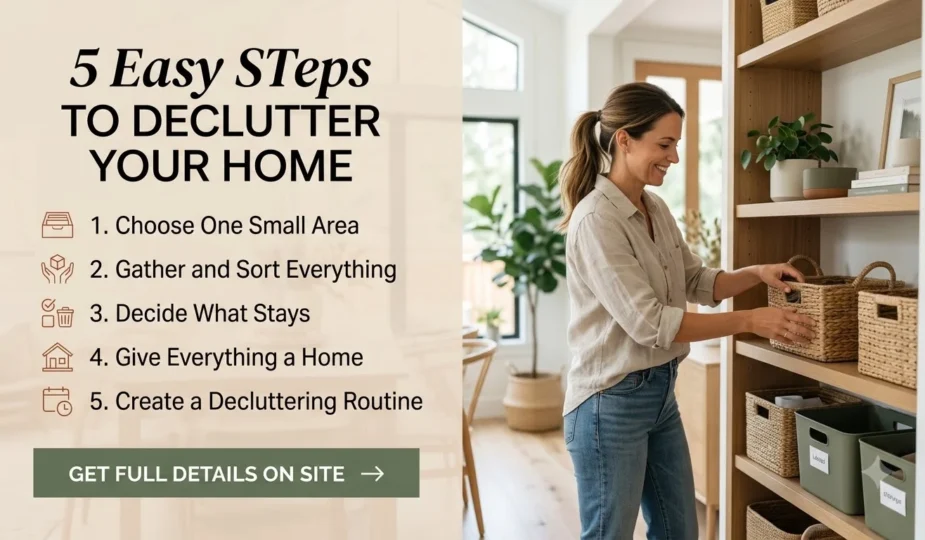
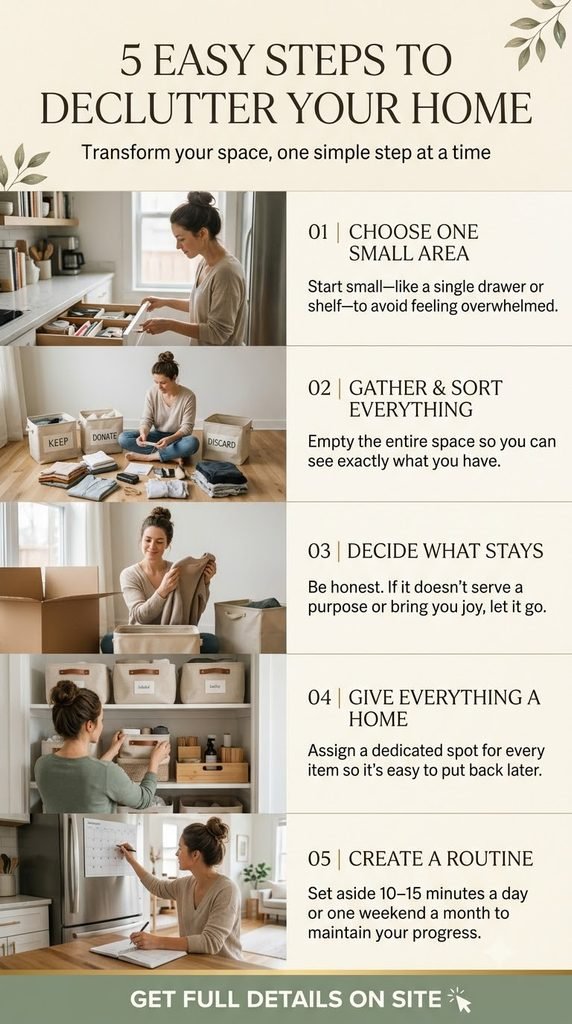
5 Easy Steps to Declutter Your Home
Step 1: Choose One Small Area to Declutter
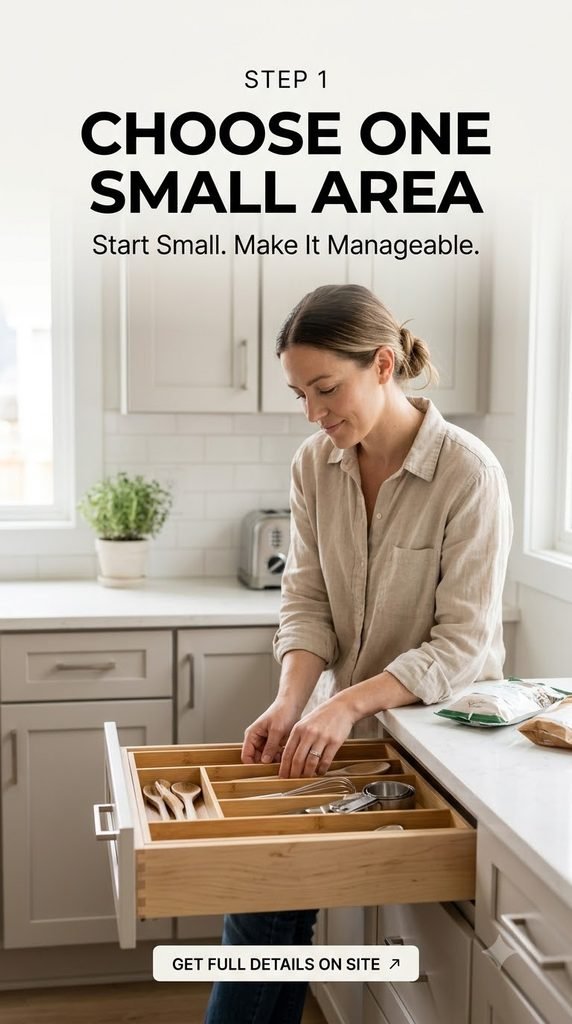
The biggest mistake is starting too big.
You look around your home and think, “Everything needs to be done.”
Then you spend 20 minutes moving things around, get overwhelmed, and stop.
Instead, choose one small area.
Good starting points include:
- One kitchen drawer
- One bathroom cabinet
- One shelf
- One section of your closet
- One nightstand
- One entryway basket
- One small corner of the living room
- One section of the garage
Don’t choose your entire house.
Choose something you can realistically finish.
Set a simple target such as:
“I’m going to declutter this one drawer before lunch.”
Finishing a small area gives you a visible result. That makes it easier to continue later.
Tip: If you’re completely overwhelmed, start with an area that doesn’t contain many sentimental items. Decisions are usually easier when you’re not sorting through years of memories.
Suggested internal link: Home Organization Checklist
Step 2: Gather Everything From That Area
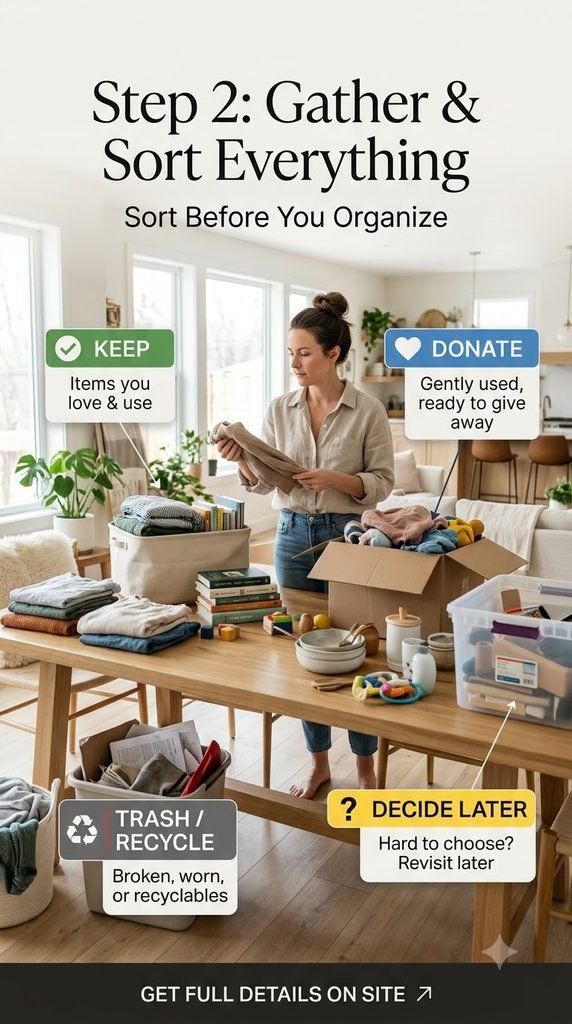
Once you’ve chosen your space, take everything out or gather everything you need to sort.
Don’t organize the items immediately.
That’s important.
If you’re decluttering a drawer, put the contents somewhere you can see them. If you’re working on a closet shelf, remove the items from the shelf before deciding what stays.
Create four simple groups:
Keep — You use it and want to keep it.
Donate — It’s useful but no longer needed by you.
Trash/Recycling — It’s broken, expired, damaged, or no longer useful.
Decide Later — You’re genuinely unsure.
That fourth category is helpful because you don’t have to force yourself to make every difficult decision immediately.
However, keep the “Decide Later” pile small.
Otherwise, it can become another storage pile.
A useful question to ask
Instead of asking:
“Could I possibly use this someday?”
ask:
“Does this item deserve the space it takes up in my home?”
That small change can make decisions easier.
Step 3: Make Decluttering Decisions One Item at a Time
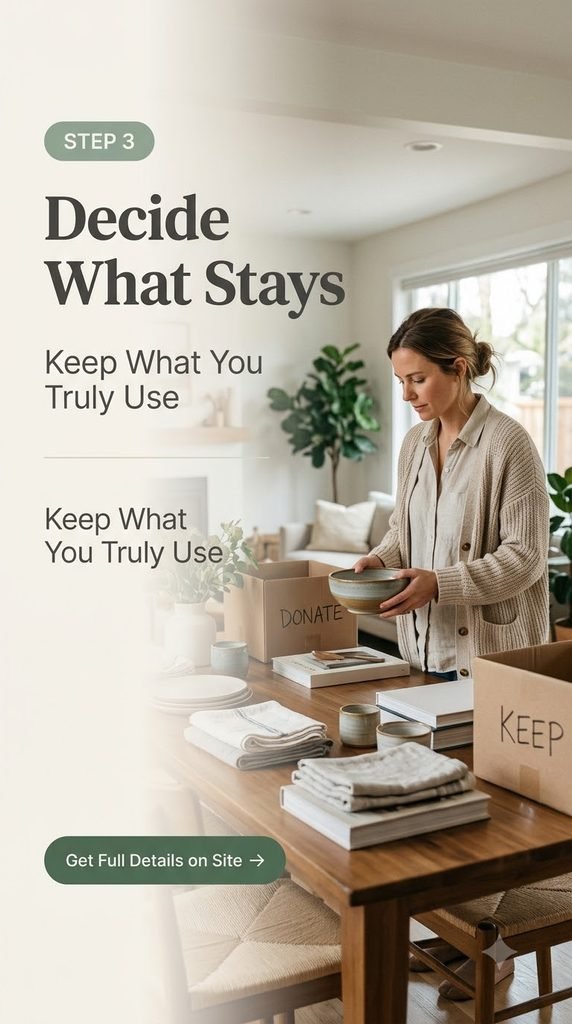
Now comes the part that actually reduces clutter.
Pick up one item.
Ask yourself:
- Do I use this regularly?
- Have I used it recently?
- Do I have another item that does the same job?
- Is it worth storing?
- Would I choose to buy it again today?
- Does it have genuine sentimental value?
- Is keeping it helping me, or simply making me feel guilty?
You don’t need to answer every question for every item.
Sometimes the answer is obvious.
A broken kitchen gadget you haven’t used in years probably doesn’t need a long emotional discussion.
But other things will be harder.
Maybe it’s an expensive dress you never wear. Maybe it’s a box of old paperwork. Maybe it’s your children’s artwork. Maybe it’s a gift you don’t particularly like but feel guilty throwing away.
Give yourself permission to slow down with those items.
Decluttering isn’t about proving how little you can own. It’s about making your home work better for your actual life.
And remember: donating something useful can be a better option than keeping it hidden in a closet forever.
Step 4: Give the Things You Keep a Real Home
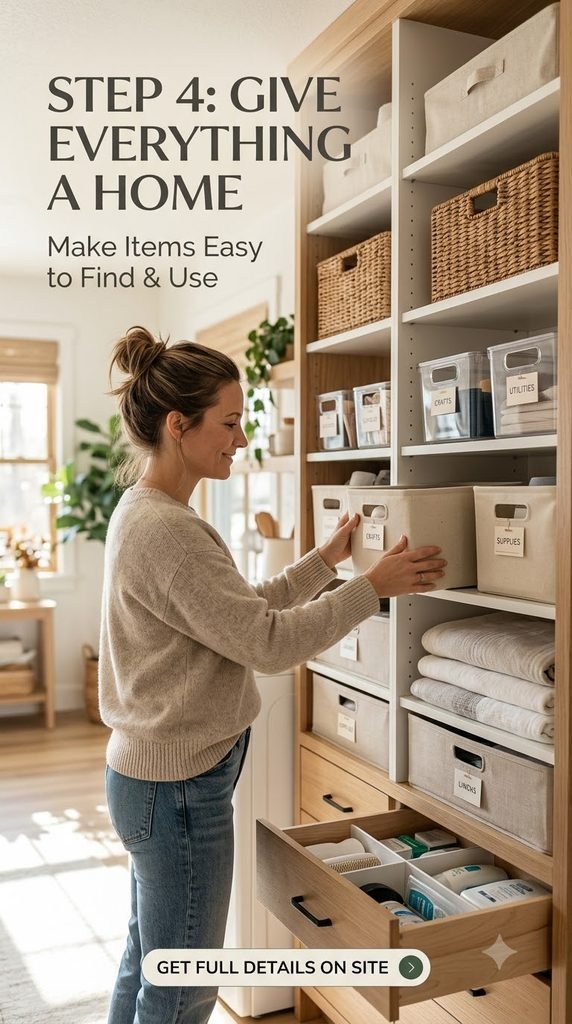
This is where decluttering and home organization connect.
Getting rid of unwanted items is only half the job.
The things you keep need somewhere to live.
For each remaining item, decide:
Where would I naturally look for this when I need it?
That’s usually the best place to store it.
For example:
- Cleaning supplies near the areas where they’re used
- Everyday kitchen tools in easy-to-reach drawers
- Important household documents in one designated location
- Frequently worn clothes where they’re easiest to access
- Batteries and small electronics in one labeled container
- Entryway essentials close to the door
You don’t necessarily need expensive storage containers.
Before buying organizers, use what you already have.
A simple basket, drawer divider, box, shelf, or labeled folder may be enough.
The best organization system is usually the one you’ll actually maintain.
Make the next action obvious
If you have to move five boxes to reach something you use every day, the system isn’t helping you.
Your home should make common tasks easier, not harder.
Step 5: Create a Small Decluttering Routine
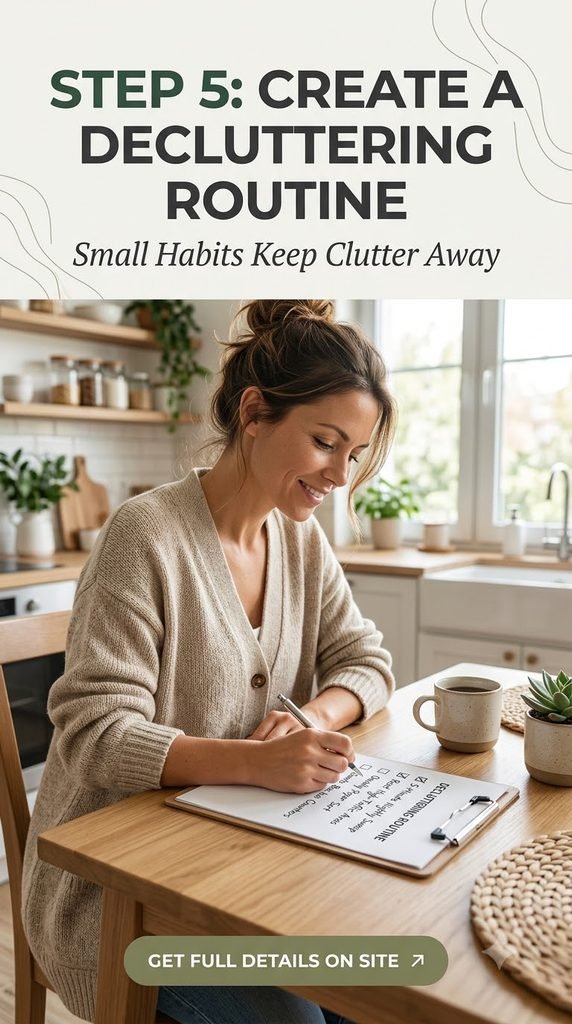
This is the step that keeps clutter from returning.
You don’t need another giant decluttering project every few months if you regularly deal with small amounts of stuff.
Try a simple routine.
For example:
Daily:
Spend 5–10 minutes returning misplaced items.
Weekly:
Choose one small area to declutter.
Monthly:
Review one larger category such as clothes, paperwork, pantry items, toys, or household supplies.
Seasonally:
Look at items that aren’t being used and decide whether they still belong in your home.
You can also use a “one in, one out” approach for certain categories. If you buy a new sweater, for example, consider whether an older sweater should leave your closet.
The point isn’t to create strict rules.
It’s to prevent small amounts of clutter from becoming another overwhelming project.
Suggested internal link: Weekly Home Cleaning
How a Declutter Routine Printable PDF Can Help
If you find yourself saying, “I know I need to declutter, but I keep forgetting where I left off,” a Declutter Routine Printable PDF can provide a simple visual system.
Instead of keeping the plan in your head, you can put the tasks on paper.
A printable routine can help you:
- Choose specific areas to work on
- Break a large project into smaller tasks
- Keep your decluttering priorities visible
- Track completed areas
- Create repeatable routines
- Reduce the number of decisions you have to remember
- See what you’ve already accomplished
- Decide what needs attention next
It doesn’t declutter the house for you.
What it does is make the process easier to see, plan, and repeat.
And sometimes that’s exactly what’s missing.
You don’t need more motivation. You need to know what you’re doing next.
What This Can Look Like in Real Life
Imagine Sarah has been trying to declutter her home for months.
Before creating a system, she keeps reminders in different places:
A note on her phone says “clean closet.”
There’s a sticky note on the refrigerator reminding her to sort paperwork.
A half-finished list is sitting on the kitchen counter.
Three bags of donations are sitting in the garage.
She knows she wants a more organized home, but every time she has free time, she isn’t sure where to begin.
Before
Problem:
Scattered notes, unfinished projects, random piles, and no clear priority.
Result:
She spends more time deciding what to do than actually doing it.
After
Sarah creates a simple decluttering routine.
She chooses one area each week.
She writes down the task.
She sorts items into simple categories.
She records what she completed.
Then she chooses the next small area.
The house doesn’t become perfectly organized overnight.
But now she has a system.
Instead of asking:
“Where do I even start?”
she can ask:
“What’s the next small task on my list?”
That difference can make the whole process feel much more manageable.
Benefits of Using Printable PDFs for Home Organization
A printable PDF is a simple tool, but it can be surprisingly useful when you’re trying to create household routines.
1. They’re Visual
Seeing your tasks on a page can make an abstract project feel more concrete.
Instead of thinking, “I need to declutter the house,” you can see exactly what you’re working on.
2. They Can Help Create Consistency
A routine becomes easier to repeat when you don’t have to recreate the plan every time.
3. They May Reduce Mental Clutter
You don’t have to remember every task in your head.
Write it down and return to the page when you’re ready.
4. They’re Flexible
You can print the pages you need and use them in a way that fits your household.
5. You Can Use Them When Needed
You don’t need to keep opening an app or searching through old phone notes.
A printed page can sit somewhere visible while you’re working.
6. They Can Make Progress Easier to See
Checking off completed tasks gives you a simple record of what you’ve already done.
That can be especially useful when a large project takes several weeks.
Why Choose an Organised My Home Declutter Printable?
At Organised My Home, the goal isn’t to make organization complicated.
The Declutter Routine Printable PDF is designed as a practical, ready-to-use system for people who want a clearer way to approach household decluttering.
The products are designed to be budget-friendly, so you can use a simple organization tool without turning it into another expensive home project.
They’re also designed as all-in-one ready-to-use resources, so you don’t have to build your own checklist from scratch.
You can print the pages you actually need and use them as part of your regular home routine.
US Letter and A4 Sizes
Because households use different paper sizes, Organised My Home printables are available in both US Letter and A4 formats.
That makes them practical for U.S. households as well as readers in other countries.
You can print them at home or use a local/online print service if you prefer a professionally printed copy.
Print Only What You Need
One advantage of a printable PDF is flexibility.
You can print a fresh copy when you need it, keep a working page on your refrigerator or home-management area, or place completed pages in a household binder.
There’s no requirement to use every page every time.
The idea is simply to have a useful system available when you need it.
Free Printables From Organised My Home
If you’re not ready to purchase a printable, that’s completely fine.
Organised My Home also provides selected free printables designed to help readers try simple home-organization tools without immediately buying a product.
Free resources can be a good way to discover which types of checklists, planners, or routines actually work for your household.
Because everyone’s home is different, the best system is the one you can realistically keep using.
Keep Your Decluttering Routine Simple
Once you’ve finished your first area, resist the temptation to immediately start another huge project.
Take a moment to notice what worked.
Maybe you discovered that 15-minute sessions are easier than an entire Saturday.
Maybe you prefer working room by room.
Maybe you need a visible checklist.
Maybe you realized that sentimental items require a separate process.
That’s useful information.
Your organization system should adapt to your real life.
If you also need to tackle cleaning after you’ve cleared the clutter, you may find it helpful to create a separate routine rather than combining everything into one enormous list.
Suggested internal link: Deep Cleaning Checklist
If household repairs and maintenance are part of the problem, keep those tasks separate as well.
Suggested internal link: Home Maintenance Checklist
And if piles of paperwork or shopping decisions are contributing to household chaos, a simple financial or planning system may help address the source rather than only the visible clutter.
Suggested internal link: Home Budget Planner
A Clutter-Free Home Doesn’t Have to Be Perfect
A clutter-free home isn’t necessarily a home with empty shelves and perfectly styled rooms.
It’s a home where the things you own are manageable enough that you can find what you need, use your spaces comfortably, and keep everyday responsibilities from constantly piling up.
Start small.
Choose one area.
Sort what you have.
Let go of what no longer serves your household.
Give the remaining items a home.
Then create a simple routine so you don’t have to start from zero again.
If you want a little help keeping that process visible, the Organised My Home Declutter Routine Printable PDF can give you a ready-made structure to work from.
And if you’re looking for more practical ways to simplify home management, explore the free printables and other organization resources from Organised My Home.
I’m Prince Mali, and through Organised My Home, I share simple, practical ideas to help make everyday home management feel a little more manageable.
You don’t have to organize your entire home today.
Just make the next small step easier.