You look around your house and realize that things have gotten out of hand. Laundry is waiting in baskets, dishes are sitting in the sink, clutter has taken over the counters, and there are little messes in almost every room. You want to get everything back under control, but figuring out where to start feels like a job all by itself.
If you have ADHD, resetting a messy house can feel especially overwhelming. You might begin picking up the living room, notice something that belongs in the bedroom, walk away to put it back, and end up doing three other things before remembering what you started. Hours can pass without making the kind of progress you hoped for.
The good news is that you don’t have to clean your entire house in one day. A realistic home reset is about making your space more manageable, one small task at a time.
I’m Prince Mali, the blogger behind Organised My Home. I share practical ideas and simple systems to help make everyday household responsibilities easier to manage. When a home feels overwhelming, I believe it helps to focus on small, repeatable actions instead of expecting yourself to do everything perfectly.
In this guide, you’ll learn how to reset a messy house in five practical steps, how to avoid common cleaning traps, and how an ADHD Cleaning Planner Printable PDF can help you organize tasks without keeping everything in your head.
Why Is Resetting a Messy House So Hard with ADHD?
A house reset sounds simple until you start thinking about everything involved. You need to collect clutter, sort laundry, wash dishes, wipe surfaces, put belongings away, and decide which rooms need attention first.
These are separate tasks that require planning, attention, prioritization, and follow-through. ADHD can make some of these executive-function skills more difficult, which may turn an ordinary cleaning session into a frustrating experience.
The Centers for Disease Control and Prevention (CDC) explains that ADHD can affect adults’ ability to stay organized and manage everyday responsibilities.
Here are some common reasons a messy-house reset becomes difficult:
- Too many starting points: Every room seems to need attention, so choosing one feels impossible.
- Task switching: You move from one chore to another whenever you notice something else.
- All-or-nothing thinking: You feel that cleaning is pointless unless you can finish the entire house.
- Unclear priorities: You spend time deciding what to do instead of getting started.
- Unrealistic expectations: You create a long cleaning schedule that doesn’t fit your available time or energy.
- Mental overload: You try to remember every unfinished chore, which leaves little room to focus on the task in front of you.
Another common problem is waiting until you feel motivated enough to tackle everything. Motivation and energy naturally vary, and a routine that depends on feeling ready may be difficult to maintain.
You don’t necessarily need a stricter schedule or more pressure. You may need a smaller starting point, clearer instructions, and a simple way to see what comes next.
How an ADHD Cleaning Planner Can Help You Reset Your Home
When your home feels messy, deciding what to do can consume almost as much energy as doing the actual cleaning.
An ADHD Cleaning Planner Printable PDF can give those tasks a clear place. Instead of relying on memory or writing reminders on random scraps of paper, you can organize cleaning priorities into a visual checklist.
A useful planner can help you:
- Identify the most important tasks for your home reset.
- Break large cleaning jobs into smaller actions.
- Choose a realistic number of chores for each session.
- Keep daily and weekly responsibilities organized.
- Track completed tasks without trying to remember everything.
- Review unfinished work and decide what can wait.
- Build a repeatable routine after the initial reset.
The planner won’t clean your home for you, and using one doesn’t guarantee that every task will feel easy. Its purpose is to make the work more visible and manageable.
For a messy-house reset, that simple structure can be especially useful. You don’t have to solve every household problem at once. You only need to know which task you’re tackling next.
How to Reset a Messy House with ADHD in 5 Steps
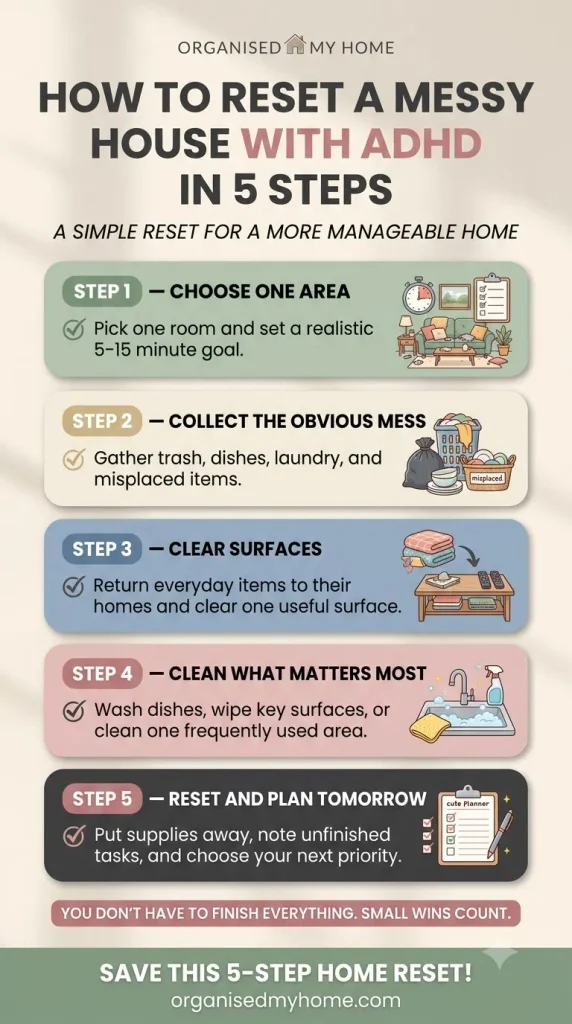
The following five-step method focuses on restoring basic order first. You can use it whether your home needs a quick evening reset or a more gradual weekend cleanup.
Step 1: Choose One Area and Set a Realistic Goal
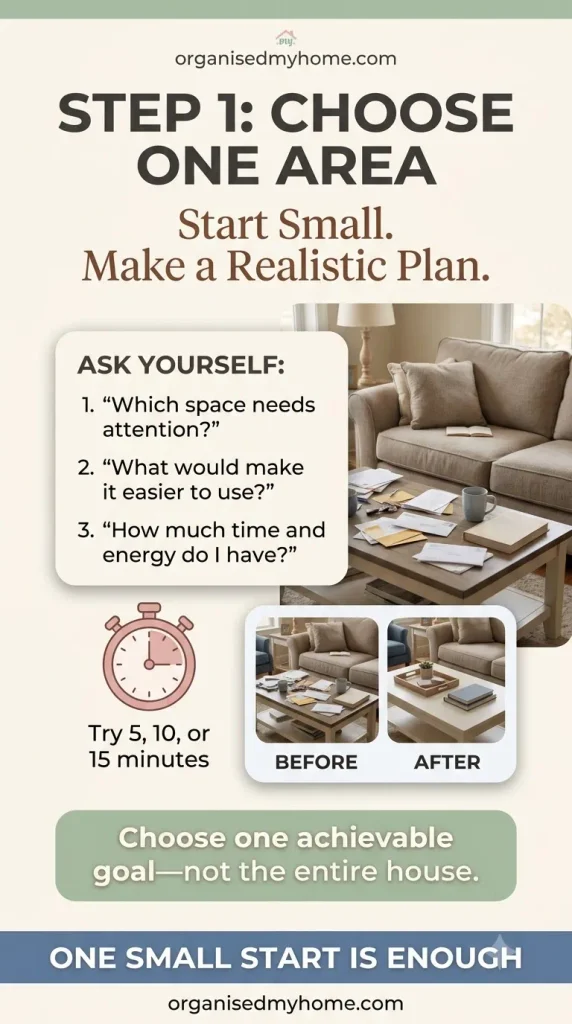
Before touching anything, take a moment to decide what would make the biggest difference today.
Don’t start by mentally listing everything that’s wrong with the house. Instead, choose one area that affects your daily life, such as the kitchen, living room, bedroom, or bathroom.
Ask yourself three questions:
- Which space is causing the most frustration right now?
- What would make this space easier to use?
- How much time and energy do I realistically have?
For example, if the kitchen is difficult to use because the counter is covered with clutter, your goal might be to clear the main food preparation area and collect the dirty dishes.
That is a more useful starting point than trying to deep-clean the kitchen, organize every cupboard, scrub the appliances, and mop the floor in one session.
Make the goal specific. Instead of writing “clean living room,” write “collect cups, put away blankets, and clear the coffee table.”
Use a short timer if it helps
Choose a manageable work period, perhaps 10 or 15 minutes. If that feels too long, begin with five minutes.
When the timer ends, you can stop, take a break, or continue if you have the energy. The timer is a tool, not a deadline you must beat.
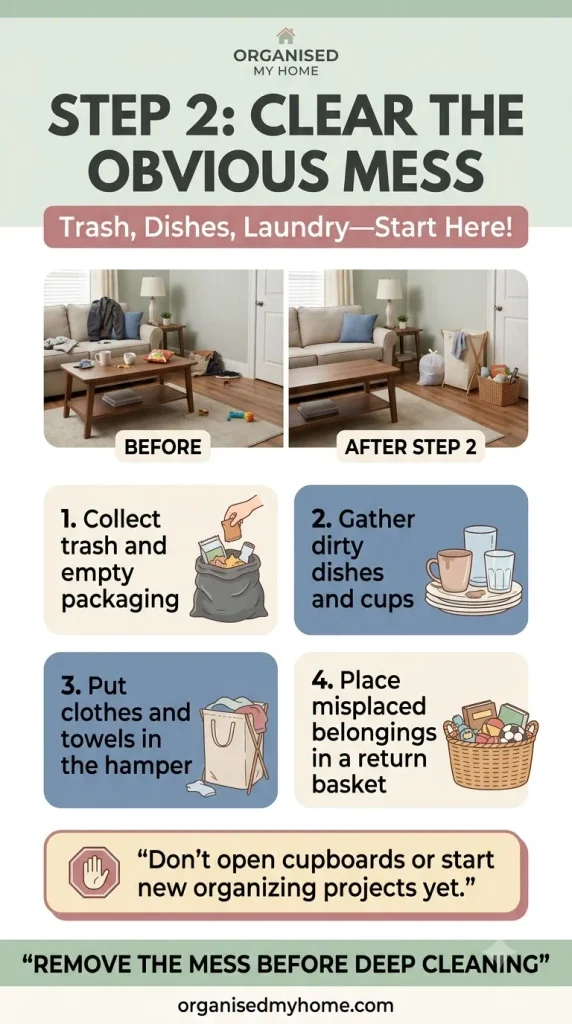
Step 2: Collect Trash, Dishes, and Laundry First
When several rooms are messy, start with the obvious items that don’t require complicated decisions.
Walk through your chosen area and collect:
- Trash and empty packaging.
- Dirty dishes and cups.
- Dirty clothes and towels.
- Items that clearly belong somewhere else.
Use a trash bag, laundry hamper, and basket for misplaced belongings. Avoid opening drawers, reorganizing shelves, or sorting sentimental items during this stage.
Those activities can easily turn a simple reset into several new projects.
For example, if you find a pile of clothes in the bedroom, put the dirty items in the hamper and place clean clothes in one designated spot for folding or putting away later.
If you find a book that belongs in another room, put it in your basket rather than immediately leaving your current task.
Your goal is to remove the obvious mess, not finish every task connected to it.
Once you’ve collected these items, take dirty dishes to the kitchen, start a load of laundry if appropriate, and dispose of the trash safely.
This first pass often makes a room feel more manageable without requiring detailed cleaning.
Step 3: Clear the Surfaces and Put Things Back
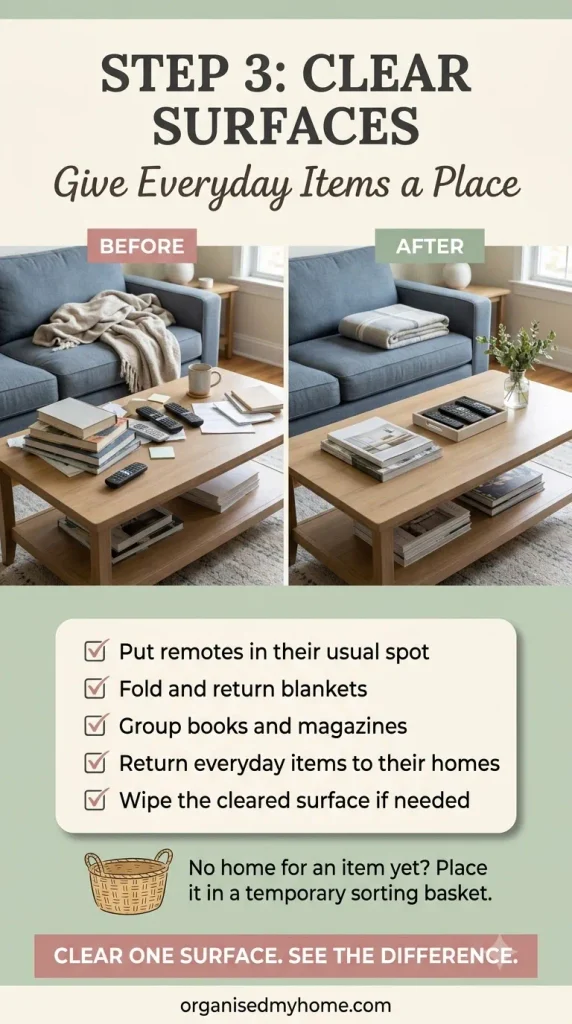
With trash, dishes, and laundry out of the way, focus on the surfaces you use most often.
You might clear the kitchen counter, coffee table, bathroom vanity, bedside table, or dining table.
Work on one surface at a time.
First, remove everything from the surface that doesn’t belong there. Then return items to their designated homes. If something doesn’t have a home yet, place it in a temporary sorting basket rather than stopping to reorganize the entire room.
For example, when resetting a living room:
- Put remote controls in their usual spot.
- Fold blankets and return them to the sofa or storage basket.
- Put books and magazines in one designated place.
- Return everyday items to their proper storage locations.
- Wipe the cleared surface if it needs cleaning.
Be careful not to create more clutter by moving piles from one surface to another. If you need a temporary basket, keep it limited to items that you can sort later.
You also don’t need to make every surface completely empty. A room can be organized and functional while still containing the belongings you use every day.
Step 4: Clean the Most Important Areas
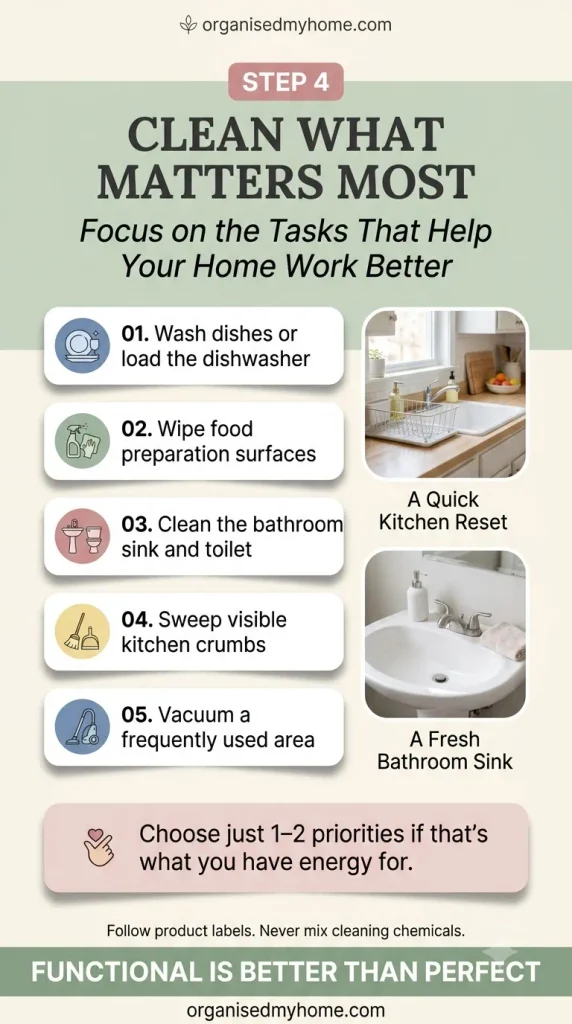
Once the obvious clutter is under control, choose the cleaning tasks that will make your home more comfortable, hygienic, and functional.
Prioritize according to your household’s needs. For many people, this might mean:
- Washing the dishes or running the dishwasher.
- Wiping kitchen food preparation surfaces.
- Cleaning the bathroom sink and toilet.
- Sweeping visible crumbs from the kitchen floor.
- Vacuuming the most frequently used living area.
- Changing bedding if it’s due.
You don’t have to do every task in every room.
A quick reset is different from a deep clean. You’re aiming to restore basic order and make everyday activities easier, not scrub every baseboard or reorganize every cabinet.
If cleaning products are needed, follow their labels and safety instructions. Never mix cleaning chemicals, and keep products safely away from children and pets.
Use a stopping point
Choose one or two important cleaning tasks and complete those before moving on. If you’re running out of energy, leave less urgent jobs for another session.
You can return to the Weekly Home Cleaning Checklist when planning regular maintenance, or use a Deep Cleaning Checklist when you’re ready to tackle more detailed jobs. These are suggested internal-link anchor texts for related Organised My Home content.
Step 5: Reset Your Space and Make a Simple Plan for Tomorrow
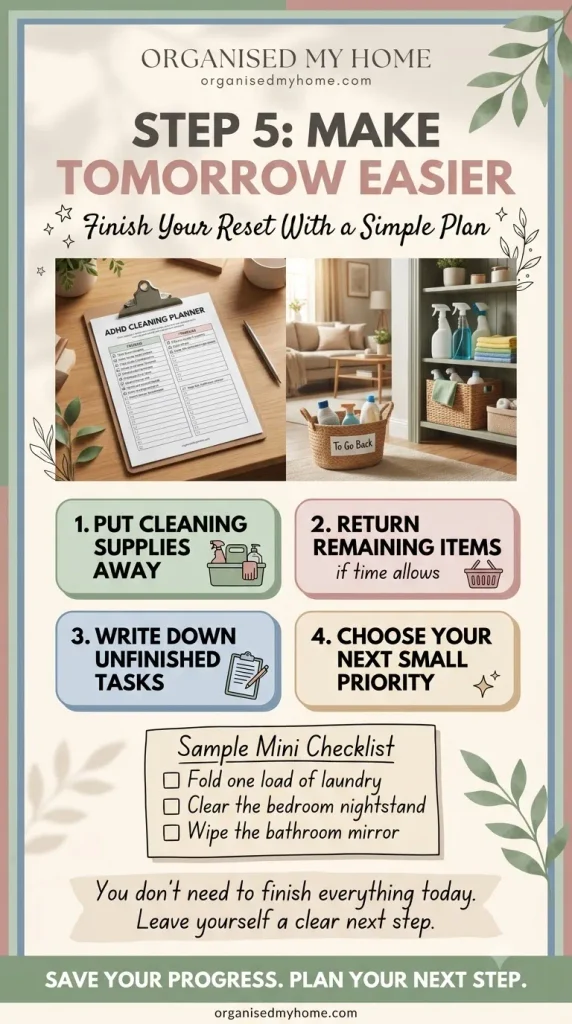
The final step is to make it easier to maintain the progress you’ve made.
Return cleaning supplies to their proper storage locations, put away the items in your sorting basket if time allows, and check that the main area is ready for everyday use.
Then take a quick look at what remains.
Perhaps the laundry still needs folding, a second bathroom needs attention, or the bedroom floor needs vacuuming. Write down the next action rather than trying to remember it.
Your plan for tomorrow might be as simple as:
- Fold one load of laundry.
- Clear the bedroom nightstand.
- Wipe the bathroom mirror.
- Spend five minutes collecting misplaced items.
Choose only the tasks that fit your next day’s schedule.
This is where an ADHD Cleaning Planner can be helpful. You can mark what you’ve completed, note unfinished tasks, and choose the next priorities without starting your decision-making process from scratch.
A successful reset isn’t necessarily one where every chore is finished. It’s one that leaves your home more usable and gives you a realistic plan for continuing.
What This Can Look Like in Real Life
Imagine someone who has a busy workweek and realizes on Saturday morning that their house needs attention. There are dishes in the sink, laundry on the bedroom floor, mail on the dining table, and clutter in the living room.
Before a simple reset system: They start in the bedroom, notice the laundry, remember that the washing machine is empty, and walk to the laundry area. On the way, they collect dishes from the living room and start washing them. Then they notice the kitchen counter and begin clearing it. Several tasks are underway, but the house still feels messy.
After using the five-step method: They choose the kitchen as their starting area. First, they collect trash, dishes, and misplaced items. Next, they clear the main counter, wash the dishes, and wipe the surface. They record the remaining laundry and living room tasks on their planner.
After a short break, they decide whether they have enough energy to continue.
The house may not be spotless by lunchtime, but the kitchen is usable, the next tasks are written down, and the person doesn’t have to keep every unfinished job in mind.
That’s the point of a home reset: make your space easier to live in without turning cleaning into an exhausting all-day project.
Benefits of Using an ADHD Cleaning Planner Printable PDF
A printable planner can be useful when you want to organize household tasks without relying entirely on memory or digital reminders.
Here are several ways it may support your cleaning routine.
It Keeps Cleaning Tasks in One Place
Instead of keeping a mental list, using sticky notes, and setting multiple phone reminders, you can record your cleaning priorities on a dedicated page.
This gives you one place to check when you’re unsure what to do next.
It Makes Progress Easier to See
When a messy house feels overwhelming, it’s easy to focus on everything you haven’t finished.
A checklist lets you mark completed tasks and see what you’ve already accomplished. Even if you’ve only completed three small jobs, you have a visible record of that progress.
It Breaks Large Jobs Into Manageable Steps
A planner can turn a vague task such as “reset the house” into smaller actions, including collecting laundry, clearing surfaces, washing dishes, and planning the next cleaning session.
Smaller steps may make getting started less intimidating.
It Supports Repeatable Routines
You can reuse a daily or weekly checklist instead of deciding from scratch which chores to do every time.
Your routine can change as your household needs change. You can also leave space for unexpected jobs rather than filling every available minute with chores.
It Offers a Flexible, Visual Reminder
A paper planner can stay on a kitchen counter, refrigerator, or clipboard where you naturally look. You can print fresh pages when needed and adapt your checklist to your own home.
A printable isn’t a substitute for professional support when ADHD symptoms significantly affect daily life. It’s simply one practical household tool you can try alongside other strategies that work for you.
Why Choose an Organised My Home ADHD Cleaning Planner?
If you would rather start with a ready-made structure than create your own cleaning pages, the ADHD Cleaning Planner Printable PDF from Organised My Home is an option to explore.
The aim is to make household responsibilities easier to organize by giving cleaning tasks a clear, practical place.
Instead of building a complete cleaning system from scratch, you can start with the planner’s available pages, choose what suits your home, and adapt the routine as you go.
Budget-Friendly and Easy to Print
Printable PDFs provide a digital format that you can print when you need it. You can use the pages that are most relevant to your routine rather than purchasing a new physical planner whenever your needs change.
Your overall cost will depend on the product price, paper, ink, and printing method. You can compare those costs with your budget and choose the option that makes sense for you.
A Ready-to-Use Starting Point
Creating a cleaning checklist takes time. You have to decide which tasks belong on it, how to organize them, and how to track progress.
A ready-made planner gives you a starting structure. You can begin using the relevant pages, remove unnecessary tasks from your personal routine, and add notes where needed.
The goal isn’t to follow every page perfectly. It’s to make the system useful for your household.
US Letter and A4 Paper Sizes
Organised My Home printable products are designed with US Letter and A4 paper options. US Letter is the standard choice for many American home printers, while A4 is useful for readers who use that paper size.
Check the specific product listing to confirm the file formats included.
You can print at home or use a local print service if you don’t have a printer. Keep the pages you use regularly somewhere accessible, and print replacements when you need them.
Free Printables From Organised My Home
You don’t have to purchase a planner to begin creating a more manageable cleaning routine.
Organised My Home also offers selected free printables for readers who want to try simple organization tools without paying for a product.
Explore the available free resources and choose one that matches a task you’re currently trying to manage. Starting with a free printable can help you discover whether paper checklists and visible reminders suit your routine.
You can always begin with a single page. There’s no need to organize your entire home management system at once.
Suggested Internal Links for Your Home Reset Routine
These related topics can provide useful next steps after your initial reset. Use the suggested anchor text when linking to the corresponding articles on Organised My Home.
Weekly Home Cleaning Checklist — for building a manageable routine after your reset.
Deep Cleaning Checklist — for planning more detailed cleaning jobs separately from everyday tidying.
Simple Home Organization Ideas — for finding practical places to store everyday belongings.
Decluttering Your Home One Room at a Time — for addressing excess belongings without trying to declutter everything in one day.
Room-by-Room Cleaning Checklist — for breaking cleaning responsibilities down by area.
These are suggested anchor texts, not verified page URLs. Link them only when the relevant articles are available on your website.
Ready to Make Your Next Home Reset Easier?
If you want a little more structure, explore the ADHD Cleaning Planner Printable PDF from Organised My Home. It can give you a starting point for organizing chores, choosing manageable priorities, and tracking your progress.
If you’d rather start without purchasing anything, explore the site’s available free printables and choose a simple tool that fits your needs.
Whichever option you choose, start small. You don’t have to wait for a completely free weekend, a burst of motivation, or the perfect cleaning mood. Choose one room, collect the obvious clutter, and complete one useful task.
Final Thoughts: A Messy House Doesn’t Mean You’ve Failed
Resetting a messy house when you have ADHD can feel difficult, especially when several rooms need attention and every unfinished chore seems to demand your attention at once.
A five-step approach can help you regain a little control: choose one area, collect obvious clutter, clear the surfaces, handle essential cleaning, and plan your next small task.
Remember that a reset doesn’t have to end with a spotless house. The goal is to create a space that feels more comfortable and easier to manage.
At Organised My Home, Prince Mali shares practical ideas and printable tools to help make everyday home responsibilities less overwhelming. An ADHD Cleaning Planner can provide a visual structure for your routine, while free printables offer another way to get started.
You don’t have to fix everything today. One manageable step is enough to begin making your home work better for you.